Emerald ash borer (EAB) has changed the look of St. Louis neighborhoods. Ash trees made up a large share of the street and yard trees planted across the region for decades, and the beetle has been working through them for years. If you have an ash on your property, you are facing one of two decisions: pay to protect it, or plan its removal before it becomes a hazard. This guide explains how to tell which situation you are in, what each option costs, and why the timing matters more than most homeowners realize. Thompson Tree Care and Landscaping has been removing and assessing ash trees across the St. Louis metro for more than a decade, and our certified arborist can look at your tree for free.
What Is the Emerald Ash Borer and How Did It Reach St. Louis?
The emerald ash borer is a small, metallic-green beetle native to Asia. It was first discovered in the United States near Detroit, Michigan, in 2002, most likely after arriving in wooden packing material. Missouri confirmed its first infestation in 2008 in Wayne County, in the southeastern part of the state, and the beetle has since spread through the St. Louis region and most of Missouri and Illinois.
The adult beetle itself does little harm. The damage comes from its larvae, which hatch under the bark and chew winding, S-shaped galleries through the layer of tissue that carries water and nutrients between the roots and the canopy. As those galleries multiply, the tree is slowly girdled from the inside. Untreated ash trees typically die within two to four years of the first infestation, and because the feeding happens out of sight, the tree often looks fine until it is already in serious trouble.
Every species of ash native to our area — white ash, green ash, and blue ash — is vulnerable. If you are not sure what kind of tree you have, ash is easy to identify: branches and buds grow in opposite pairs, leaves are compound with five to eleven leaflets, and mature bark forms tight, diamond-shaped ridges.
What Are the Signs of Emerald Ash Borer Damage?
EAB symptoms show up in a predictable order. The earlier you catch them, the more options you have.
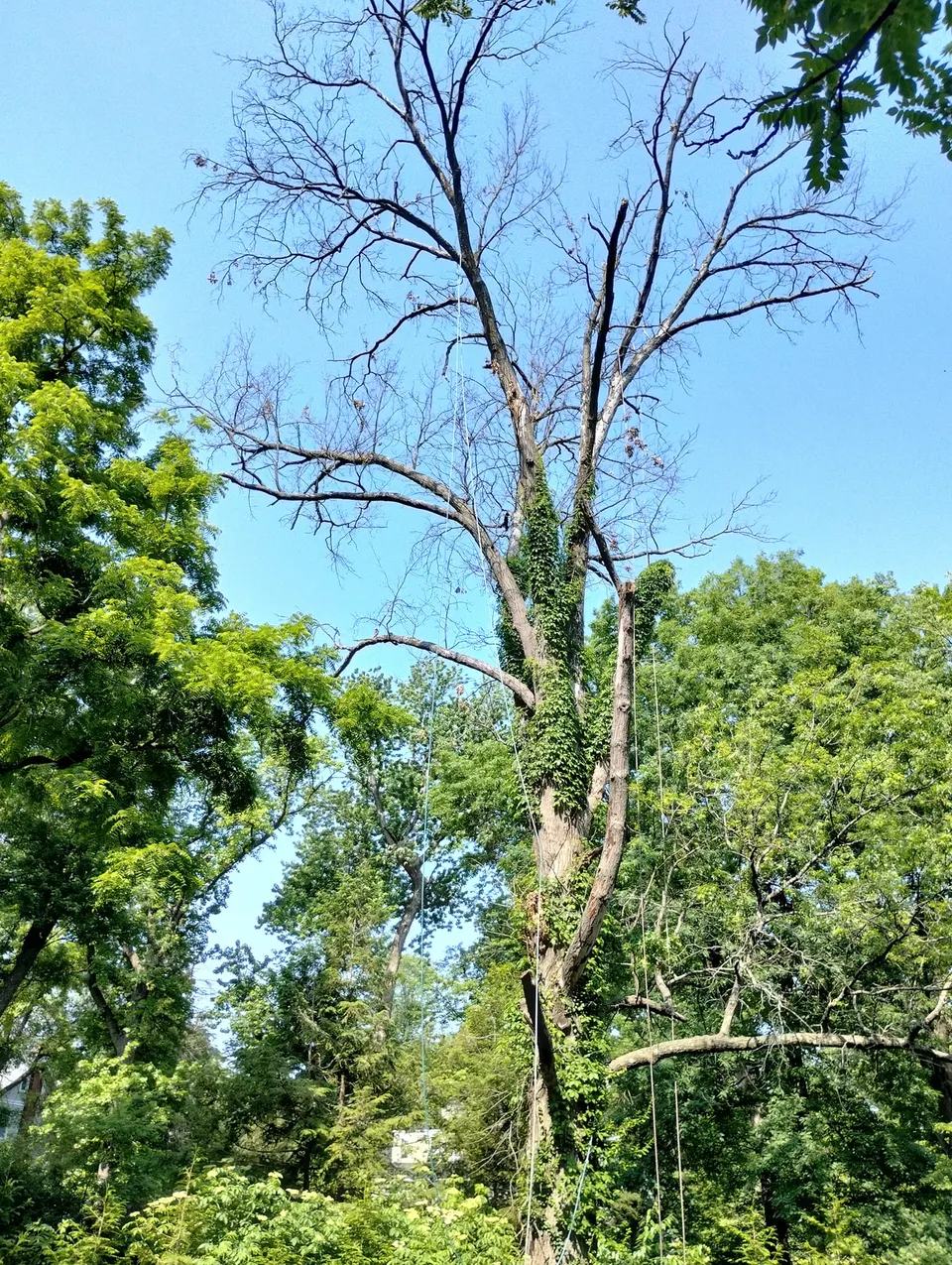
- Canopy dieback from the top down — Thinning leaves and bare twigs in the upper third of the crown are usually the first visible sign. The tree is losing the branches farthest from its roots first.
- Heavy woodpecker activity — Woodpeckers feed on EAB larvae and strip away the outer bark to reach them. Patches of pale, freshly exposed bark high on the trunk, sometimes called "blonding," are a strong indicator.
- D-shaped exit holes — Adult beetles leave the tree through holes about 1/8 inch across with one flat side. They are small and easy to miss, so check the trunk and larger limbs closely.
- Epicormic sprouts — Clusters of new shoots growing straight out of the trunk or the base of large limbs are a stress response. The tree is trying to grow leaves below the damaged zone.
- Vertical bark splits — As galleries expand, the bark cracks open along the trunk. Look inside the split and you may see the serpentine tunnels packed with sawdust-like frass.
- S-shaped galleries under loose bark — If a piece of bark comes away easily and reveals winding tracks in the wood beneath, the infestation is advanced.
Because the earliest damage is hidden, an ash showing even mild top dieback in the St. Louis area should be assumed infested until an arborist confirms otherwise. Many of the warning signs overlap with general decline, so our guide to how to tell if a tree is dead or dying is worth reading alongside this one.
Should You Treat or Remove an Infested Ash Tree?
The decision comes down to three questions: how much canopy is left, how valuable the tree is to your property, and how close it stands to things it could damage.
Treatment makes sense when:
- The tree still has more than roughly 50% of its canopy.
- It is a healthy, well-formed shade tree that adds real value — cooling your house, framing the yard, or anchoring the landscape.
- It has room to grow and is not already conflicting with your roof, foundation, or power lines.
- You are willing to budget for repeat treatments every two to three years for the life of the tree.
Removal makes sense when:
- Canopy loss is already past 30–50%. Treatment at this stage rarely restores the tree.
- Bark is splitting and woodpecker flecking covers much of the trunk.
- The tree overhangs your house, garage, driveway, or a neighbor's property.
- The tree was poorly placed or in mediocre shape before the beetle arrived. Paying to protect a marginal tree for decades rarely pays off.
Homeowners with several ash trees often do both: treat the one or two specimen trees that matter most and remove the rest. Our arborist can walk the property with you and help you sort them.
How Does Emerald Ash Borer Treatment Work?
The most reliable protection for a mature ash is a trunk injection of a systemic insecticide, most commonly emamectin benzoate, applied by a licensed pesticide applicator. Small ports are drilled around the base of the trunk, the product is injected directly into the tree's vascular system, and it moves up into the canopy where it kills larvae as they feed. One properly timed injection generally protects the tree for two to three years.
Timing matters. Injections are most effective in spring and early summer, once the tree has leafed out and is actively moving water, and before the new generation of larvae has done a season's worth of damage. Late-summer and fall treatments are less effective because uptake slows.
Soil drenches and bark sprays with other products exist, but they are generally weaker on large trees and need to be repeated every year. For an ash bigger than about 12 inches in trunk diameter, trunk injection is the standard recommendation.
Thompson Tree Care does not apply insecticides ourselves, but we can assess whether your tree is a good candidate and coordinate treatment with a licensed applicator as part of a complete plan for your property.
What Does Treatment Cost Compared With Removal?
Trunk injection is usually priced by the inch of trunk diameter, measured at chest height, and often falls in the range of $10 to $15 per inch. A typical 20-inch yard ash would run about $200 to $300 per treatment, repeated every two to three years. Over 20 years that adds up, but it is spread out, and you keep the shade, the property value, and the cooling a mature tree provides.
Removal is a one-time cost, but it is a bigger one. As we explain in our guide to how much tree removal costs in St. Louis, most residential removals fall between $300 and $2,500 depending on size and access, and a mature ash usually lands in the middle to upper part of that range. Dead ash removals often run higher than a comparable healthy tree because crews cannot safely climb brittle wood and may need a bucket truck or crane. Add stump grinding if you want the area cleared for replanting — see our stump grinding service for what that involves.
The math usually favors treatment for a healthy, valuable ash and removal for anything already in decline. What rarely makes sense is doing nothing, because that is the most expensive path of all.
Why Is Waiting to Remove a Dying Ash Dangerous?
Ash wood dries and loses strength unusually fast after the tree dies. Within a year or two, limbs that would have flexed under a climber's weight snap instead. Large dead limbs shed without warning, sometimes on calm days, and the whole trunk can fail at the base once decay sets in. Around the St. Louis area, storm season turns a standing dead ash into a serious liability for your roof, your vehicles, and anyone walking beneath it.
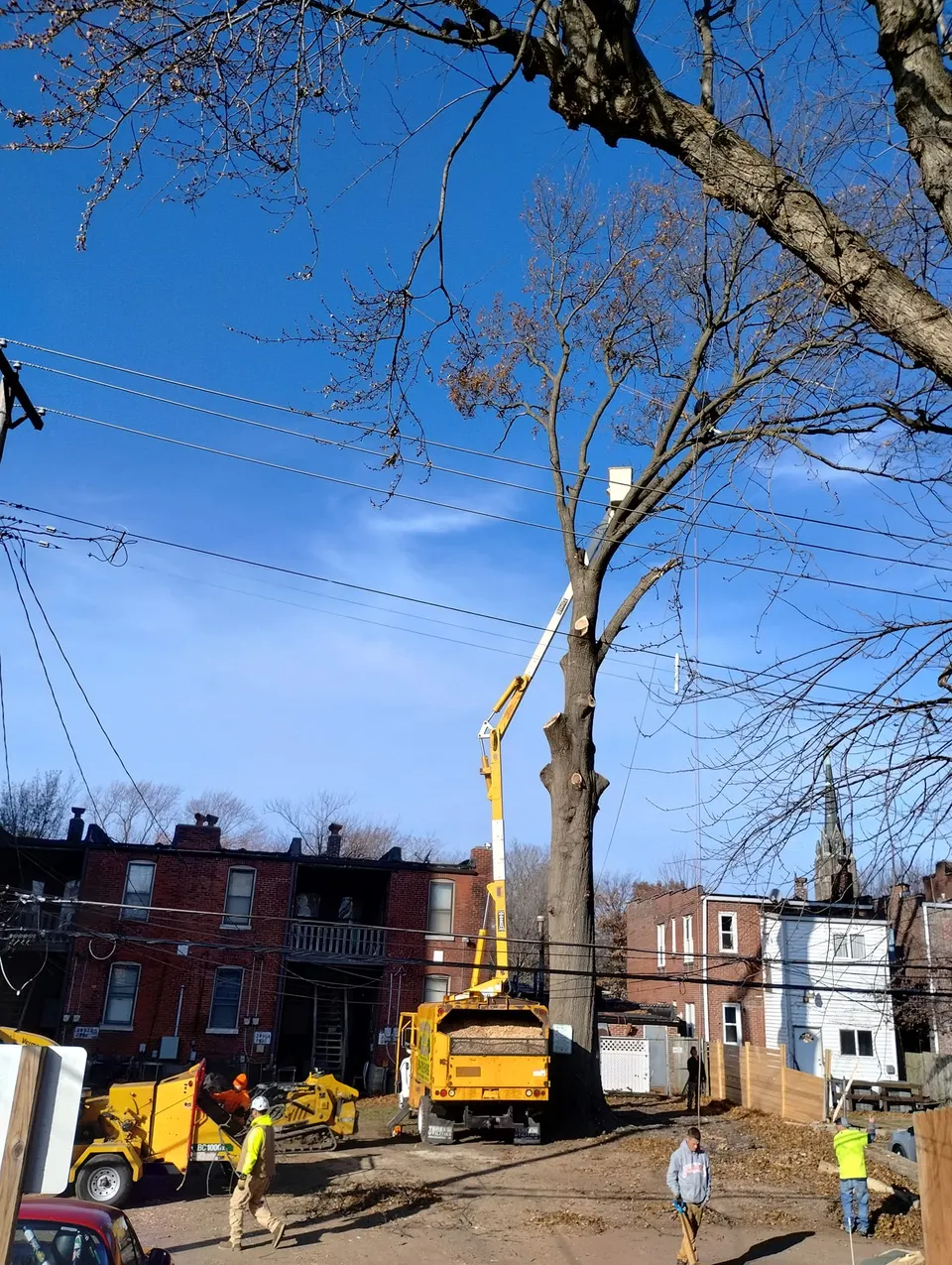
That brittleness is also why the price climbs. A live ash can be dismantled by a climber working piece by piece. A dead one usually has to be taken down from a bucket truck or with a crane, which means more equipment, more crew time, and a higher quote. When a tree reaches that stage, it falls under our dangerous tree removal service, and very large specimens are handled by our large tree removal crew with the rigging to bring them down safely near structures.
If the tree is already dropping limbs or leaning, do not wait for a scheduled appointment. Thompson Tree Care answers emergency tree service calls 24/7 at (314) 712-3035.
What Should You Plant in Place of a Removed Ash?
The lesson of the emerald ash borer is diversity. Ash was planted so widely that a single pest could hollow out entire streets. When you replace a removed ash, choose a species that is well suited to Missouri's climate and not already over-represented on your block:
- Oaks — White oak, bur oak, and swamp white oak are long-lived, storm-resistant, and support enormous amounts of wildlife.
- Hackberry — A tough native that tolerates heat, drought, and poor soils and grows into a broad shade tree.
- Kentucky coffeetree — Striking form, few pest problems, and very tolerant of urban conditions.
- Bald cypress — Handles wet spots and clay, grows quickly, and holds up well in wind.
Give the new tree a spot with enough room for its mature size, away from foundations and overhead lines, and it will not present the same problems its predecessor did.
What Should St. Louis Homeowners Do Next?
Walk out and look at your ash trees now, while they are in leaf. Compare the density of the upper canopy with the lower branches, scan the trunk for pale woodpecker patches and sprouts, and check for splits. If you see any of these signs, or you simply are not sure what you are looking at, schedule a free on-site assessment.
Thompson Tree Care and Landscaping has been serving St. Louis, Kirkwood, Chesterfield, Florissant, O'Fallon, and Belleville, IL, since 2014, with more than 500 jobs completed and a 4.8-star Google rating from 60+ reviews. We are licensed and insured, we offer free estimates, and we provide senior and veteran discounts. Whether the answer is to treat, remove, or simply monitor, you will get a straight recommendation. Call (314) 712-3035 or request a free estimate online.
Frequently Asked Questions
Often, yes, if you act early. An ash that still has more than about half of its canopy and shows only early symptoms can usually be protected with a professional trunk injection of emamectin benzoate, repeated every two to three years. Once a tree has lost more than 30 to 50 percent of its crown, treatment rarely brings it back and removal is the safer choice.
Professional trunk injection is typically priced by trunk diameter, often in the range of $10 to $15 per inch measured at chest height. A 20-inch ash would run roughly $200 to $300 per treatment, repeated every two to three years. Compare that with a one-time removal of $700 to $2,500 or more for a mature ash, and treatment is usually the cheaper option for a healthy, well-placed tree.
Untreated ash trees typically die within two to four years of infestation. Because larvae feed under the bark where you cannot see them, most homeowners notice thinning at the top of the canopy one or two years after the beetles arrive. By the time bark is splitting and woodpeckers are stripping the trunk, the tree is usually in its final year.
Ash killed by emerald ash borer dries out and becomes brittle quickly. Within a year or two of dying, limbs can snap under a climber's weight, so crews often have to use a bucket truck or crane instead of climbing. That extra equipment and the added risk raise the price, which is why arborists recommend removing a dying ash promptly rather than waiting for it to fail.