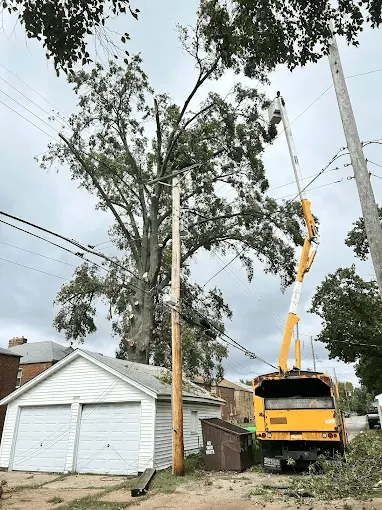
Dangerous Tree Removal in St. Louis, MO
A tree is dangerous when a crack, rot, dead wood, or a moving lean puts it at risk of falling on something that matters. Thompson Tree Care clears the fall zone and assesses the tree first, then takes it down in controlled sections. Licensed, insured, rated 4.8★ from 65 Google reviews.
What Makes a Tree Dangerous?
A tree is dangerous when it has a defect likely to fail and a target it would hit. The defect is a crack, decay, dead wood, or a lean that is getting worse; the target is your house, a car, a power line, a fence, or a spot where people walk. Thompson Tree Care and Landscaping's first move on any dangerous tree in St. Louis is to keep people out of the fall zone, check for power-line contact, and have our certified arborist judge whether the tree needs removal, cabling, or corrective pruning.
Not every old or ugly tree is dangerous. These are the conditions that most often turn a St. Louis tree into a real hazard:
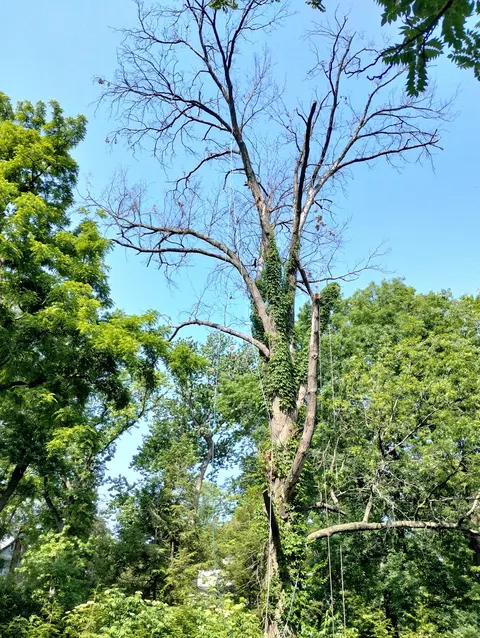
Dead Branches in the Upper Canopy
Large dead limbs, sometimes called widow-makers, can break off without warning and fall with enough force to cause serious injury or damage vehicles and structures parked below.
Root Damage or Decay
Trees with compromised root systems from construction damage, soil erosion, or root rot can topple in moderate winds. You may notice the ground heaving or cracking around the base.
Significant Lean
While many trees naturally grow at a slight angle, a tree that has recently started leaning or whose lean has increased signals root failure. This is especially dangerous after periods of heavy rainfall that saturate Saint Louis clay soils.
Proximity to Structures & Power Lines
Trees growing into or touching power lines create fire and electrocution risks. Trees hanging over your roof, garage, or play area put your family and property at risk every time the wind picks up.
Pest Infestation
Emerald ash borer has devastated ash trees across the Saint Louis region, leaving behind structurally weakened trees that can fail unpredictably. Other boring insects weaken wood integrity from the inside out.
Bee & Wasp Colonies
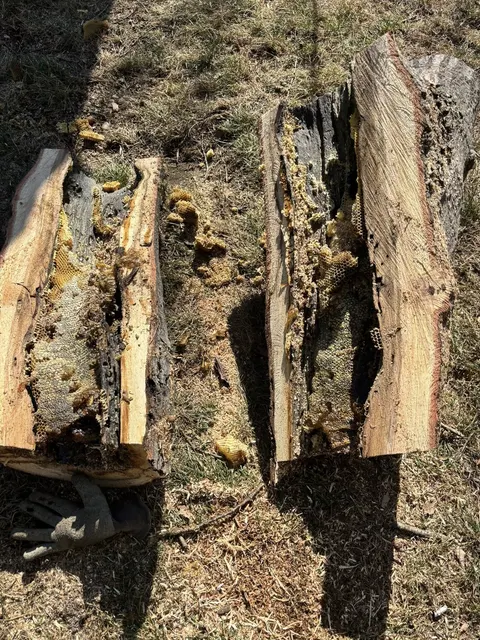
Trees harboring active bee or wasp colonies add a layer of danger to an already hazardous situation. Removing these trees requires careful coordination to protect the crew and nearby residents.
What Does Thompson Tree Care Do First With a Dangerous Tree?
Thompson Tree Care makes the area safe before anyone touches the tree. On every dangerous tree job in St. Louis, the crew secures the fall zone, rules out power-line contact, and assesses the defect, and only then plans the removal. That order keeps a bad tree from becoming an injury or a second insurance claim.
- Clear the fall zone. Everyone, including pets and parked cars, moves at least one and a half tree-heights away. A tree that might fail does not get a crowd underneath it.
- Check the lines. If the tree or a limb touches a service drop or a street line, Ameren is called first and the crew waits for the line to be de-energized. Nobody cuts a tree that is in contact with a live wire.
- Find the defect. The certified arborist looks at the trunk, the root plate, the major unions, and the canopy: is the crack opening, is the soil heaving on one side, is the base hollow, are there fungal conks, is dead wood hanging over a roof?
- Decide remove, reduce, or support. Some trees can be made safe with a reduction cut or cabling and bracing. A tree with a failing root plate or advanced trunk decay comes down.
- Plan the rigging. The crew picks tie-in points in sound wood, sets the cut sequence, and positions ropes and lowering devices so each section comes down under control rather than dropping onto the house, fence, or garden.
- Remove, clean up, and document. Wood is chipped or hauled, the yard is raked clean, and, when damage has already happened, the crew photographs the tree and the damage for your insurance claim.
How Urgent Is a Dangerous Tree?
A dangerous tree is an emergency when it is actively moving, touching a line, or already on a structure; it is a schedule-this-week job when the defect is serious but stable. Thompson Tree Care answers both at (314) 712-3035, with 24/7 response for the first group.
Call right now (24/7)
- A tree or large limb is on the house, garage, or car.
- A broken limb is hanging in the canopy over a door, driveway, or sidewalk.
- A fresh crack in the trunk is opening or creaking in wind.
- The soil on one side of the trunk has lifted after a storm and the lean is new.
- The tree is resting on a power line (call Ameren first).
Book an assessment this week
- A dead tree, or a dead ash killed by emerald ash borer, still standing near the house.
- Mushrooms or shelf fungus at the base or on the root flare.
- A hollow or cavity in the trunk.
- An old lean that has not changed but sits over a roof or play area.
- Large dead limbs in the upper canopy.
Our guides on when a leaning tree is a problem, hollow trees, and signs a tree is dead or dying explain each one.
How We Handle Dangerous Tree Removal
Dangerous tree removal in Saint Louis, MO is not a standard tree job. It requires specialized equipment, advanced training, and meticulous planning. At Thompson Tree Care, our approach to every hazardous tree follows a proven protocol designed to minimize risk to your property and our crew.
We begin with a thorough hazard assessment. Our certified arborist examines the tree's structural integrity, identifies failure points, maps the fall zone, and evaluates obstacles including power lines, fences, sheds, neighboring properties, and underground utilities. Based on this assessment, we create a detailed removal plan that specifies the sequence of cuts, rigging points, and equipment positioning.
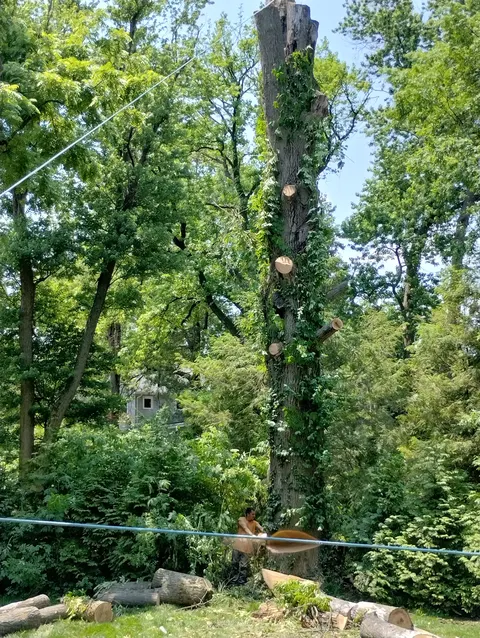
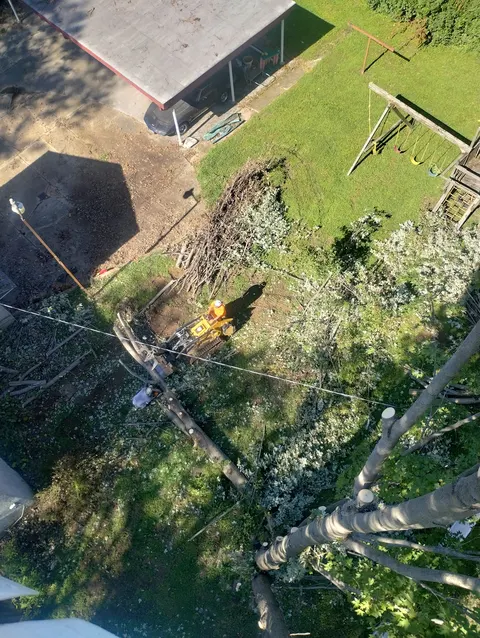
For trees near power lines, we coordinate with Ameren Missouri when necessary and maintain strict OSHA-mandated clearance distances from energized conductors. Our climbers use advanced rigging systems to lower sections of the tree piece by piece in controlled descents, rather than felling the tree in one cut, which would be catastrophic in a tight residential setting.
Why Do So Many St. Louis Trees Become Dangerous?
St. Louis trees fail for three local reasons: heavy clay soil, big old trees on small lots, and hard summer storms. Thompson Tree Care and Landscaping sees the same patterns across the metro. Clay holds water after long rains, so saturated root plates let go in wind that a tree would normally shrug off. Silver maples and Bradford pears, both common here, grow weak unions that split. And emerald ash borer has left dead ash standing in yards across St. Louis County.
Where you live changes the job. In St. Louis City, dangerous trees usually sit between a brick house, an alley, and overhead lines, so nearly every removal is climbed and rigged. In Kirkwood, century-old oaks lean over narrow side yards and detached garages. Out in Chesterfield, larger lots give more room, but the trees are often bigger and farther from the driveway. Across the river in Belleville, old parkway trees add a city-ownership question before any cut.
If the tree is dangerous because of its size alone, the large tree removal page covers crane and rigging decisions, and if you are weighing cost, the tree removal cost guide breaks down what drives the price.
Why You Should Never Attempt Dangerous Tree Removal Yourself
We cannot stress this enough: dangerous tree removal is not a DIY project. Every year, homeowners across the country are killed or seriously injured attempting to remove hazardous trees themselves. The risks include electrocution from contact with power lines, being struck by falling limbs that kick back unpredictably, chainsaw accidents caused by working at heights or in awkward positions, and the tree falling in an unintended direction due to hidden decay or structural weakness.
Beyond personal safety, an untrained person removing a tree that damages a neighbor's property or utility infrastructure can face significant liability. Thompson Tree Care carries comprehensive liability insurance that protects you throughout the entire removal process. Our crew members are trained in OSHA safety standards and use professional-grade protective equipment on every job.
If you suspect a tree on your property is dangerous, the safest thing you can do is call (314) 712-3035 for a free professional assessment. For situations that cannot wait, our 24/7 emergency tree service is available around the clock.
Last Updated: September 2026
Frequently Asked Questions About Dangerous Trees
Signs of a dangerous tree include large dead branches in the canopy, visible cracks or splits in the trunk, mushrooms or fungal growth at the base, a noticeable lean that has developed recently, exposed or heaving roots, bark falling off in large sections, and hollowed trunk sections. If you notice any of these signs, contact Thompson Tree Care for a professional hazard assessment.
For trees touching or within 10 feet of power lines, first contact Ameren Missouri at 1-800-552-7583 as they handle vegetation in their right-of-way. For trees on your property that are near but not touching power lines, call Thompson Tree Care at (314) 712-3035. Our crews are trained in working near energized lines and follow OSHA safety protocols.
Dangerous tree removal in Saint Louis typically costs between $800 and $4,000+ depending on the tree size, location, and specific hazards involved. Trees near power lines or structures require specialized equipment and techniques that add to the cost. Thompson Tree Care provides free on-site assessments with transparent pricing.
Homeowner's insurance often covers dangerous tree removal when the tree poses an imminent threat to your property or has already caused damage. Coverage varies by policy, so contact your insurance provider to confirm. Thompson Tree Care provides detailed documentation to support insurance claims.
Sometimes. A tree with one weak union or a single bad limb can often be made safe with a reduction cut or cabling and bracing, and Thompson Tree Care's certified arborist will say so in the free estimate. A tree with a lifting root plate, advanced trunk decay, or a crack running through the main stem is removed.
Other Services You May Need
Emergency Tree Service
- Available 24/7/365
- Rapid storm response
- Fallen tree removal
Large Tree Removal
- Crane & heavy equipment
- 60'+ tree specialists
- Complex removal experts
Tree Trimming & Pruning
- Crown thinning & shaping
- Deadwood removal
- Health & aesthetic pruning