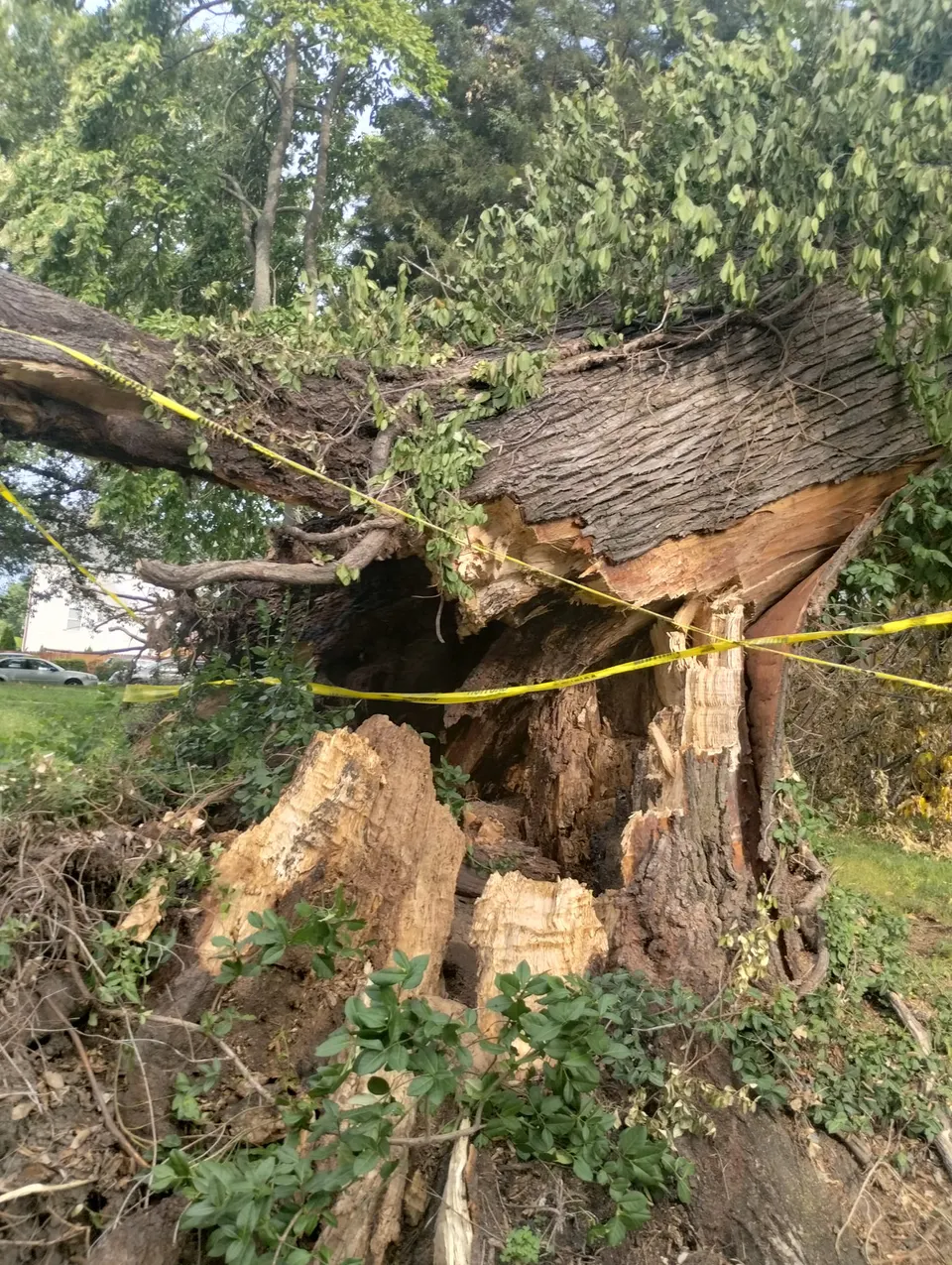
Most St. Louis homeowners find out a tree is hollow by accident: a limb breaks off and the stub is empty inside, a raccoon moves into a cavity, or a stump grinder opens up a trunk that looked solid from the outside. The instinct is to assume the tree is dying and has to come down. Sometimes that is right. Just as often, the tree has been hollow for thirty years, is growing normally, and will outlast the house. Thompson Tree Care and Landscaping has assessed hollow oaks, maples, sycamores, and cottonwoods across the metro since 2014, and this guide explains why a hollow tree can be healthy, what actually turns one into a hazard, how arborists measure the difference, and what your options are once you know.
Why can a hollow tree still be alive?
A trunk is not solid living tissue all the way through. Only the outer band, the sapwood and the thin layer of cambium just under the bark, carries water and nutrients and adds new growth each year. The heartwood in the center is older wood the tree has already retired. It is dead tissue, chemically toughened to resist decay, and its only job is structural. When fungi eventually get past that resistance, usually through an old wound, a broken limb, or a root injury, they digest the heartwood from the inside out. The living cylinder around it keeps functioning, which is why a tree can be hollow and still leaf out fully every spring.
There is also an engineering reason hollow trees stand as well as they do. A hollow tube is remarkably efficient at resisting bending; most of a trunk's strength comes from the wood farthest from the center. Engineers build bicycle frames and scaffolding as tubes for the same reason. That is why arborists do not ask "is it hollow?" but "how much wall is left, and where?"
When does a hollow tree become dangerous?
Hollowness turns into hazard when the shell can no longer carry the load of the crown above it, or when the decay has moved somewhere the shell cannot compensate for. The warning signs arborists weigh most heavily:
- A thin shell. The rule of thumb used in tree risk assessment is that the ring of sound wood should be at least about one-third of the trunk's radius. A 30-inch trunk (15-inch radius) needs roughly five inches of solid wood all the way around. Less than that, and the margin of safety in a strong wind gets thin fast.
- A large opening. A closed cavity keeps the tube intact. An opening that spans a third or more of the circumference breaks the tube, and the strength drops far more than the missing wood would suggest.
- Decay at the base or root flare. A hollow limb is a limb problem; a hollow trunk at ground level is a whole-tree problem, because the roots and butt carry everything. Soft, punky wood at the flare, or soil heaving on one side, is the most serious version of hollow.
- Mushrooms or shelf fungi on the trunk or at the base. Those are the fruiting bodies of the fungus doing the hollowing, and conks at the root flare in particular point to advanced decay. Our guide to mushrooms growing on a tree explains which growths matter most.
- Lean, especially a new lean, toward a house, driveway, or play area.
- Cracks running vertically from the cavity, or a seam where the shell has started to split.
- Recent canopy dieback. A hollow tree that is also thinning from the top is losing the living shell too, and the tree's ability to compartmentalize the decay is failing. See the eight signs a tree is dead or dying.
Any one of these on its own warrants a look. Two or three together, on a tree with something valuable underneath it, usually means the tree's time is up.
How do arborists check a hollow tree?
A proper assessment is more than a glance from the driveway, and it does not require damaging the tree.
- Visual inspection. The arborist walks the full circumference and looks up: cavity size and location, fungal growth, cracks, old wounds, dead limbs, lean, and the condition of the crown compared with nearby trees of the same species.
- Sounding. Tapping the trunk with a mallet. Solid wood rings; decayed wood gives a dull thud. Done all the way around and at several heights, sounding maps roughly where the hollow is and how far up it runs.
- Probing. A thin rod pushed into a cavity or into soft wood at the base measures how deep the decay goes and whether it reaches the roots.
- Resistance drilling or sonic tomography. For a high-value tree where the answer is close, a resistance drill measures wood density through the trunk with a needle-thin bit, and a sonic tomograph builds a cross-section image from sound waves. Both give an actual shell-thickness number instead of an estimate.
- Root flare and soil. Pulling back mulch or turf at the base to check the flare, and looking for lifted or cracked soil on the side opposite the lean.
- Target assessment. What would the tree, or the hollow limb, hit if it failed? A hollow oak over an open back lawn and the same oak over a bedroom are two different risk decisions, even with identical wood.
Our certified arborist assessment covers all of this and ends with a plain recommendation: leave it, reduce it, support it, or remove it.
Can a hollow tree be saved?
Often, yes. If the shell measures out adequately and the decay is confined to the upper trunk or a single limb, the goal becomes reducing the load the shell has to carry and keeping the living tissue healthy.
- Crown reduction. Carefully shortening the longest limbs and thinning dense outer growth lowers the sail area and the leverage wind puts on the hollow section. This is skilled pruning work, not topping, which would create new decay entry points and make things worse.
- Cabling and bracing. Where the hollow has produced a split leader or a weak union above the cavity, cabling and bracing can carry part of the load and keep two halves from tearing apart in a storm.
- Leave the cavity alone. Do not fill it with concrete, foam, or mortar. Fillings add weight, trap moisture against the living wood, hide the progress of decay, and turn a future removal into a hazard for the crew cutting into it. Do not carve or "clean out" the cavity either; the wound wood around it is the tree's own barrier. Leave it open so it drains.
- Reduce stress. Mulch out to the drip line, water deeply in drought, keep mowers and vehicles off the root zone, and avoid grade changes or trenching near the trunk.
- Re-check it. A hollow tree that stays is a tree on a schedule. An inspection every year or two, and after any major storm, catches the point where the balance tips.
Hollow trees also have real value beyond the yard. Cavities shelter owls, woodpeckers, bats, and squirrels, and a stable hollow tree away from targets is worth keeping for that reason alone.
When should a hollow tree come down?
Removal is the right call when the numbers and the location both point the same way:
- The sound-wood shell is under the one-third guideline, or a cavity opening spans a large share of the trunk, and the tree carries a big crown.
- Decay or conks are at the root flare, or the tree has started to lean or heave soil.
- The tree stands over the house, garage, driveway, sidewalk, a neighbor's structure, or anywhere people gather. Our guide to trees growing too close to a house covers how targets change the math.
- The crown is also declining, which means the tree can no longer wall off the decay.
- The hollow is in a species prone to sudden failure, such as silver maple, cottonwood, or Bradford pear, where brittle wood gives little warning.
A thin-walled hollow tree over a target is exactly the kind of job our dangerous tree removal crew is built for, and for stable trees in the open, a standard tree removal is straightforward. Either way, the decision should be made on evidence, not on the sight of a cavity.
What does it cost to remove a hollow tree?
Typical St. Louis-area tree removal runs $300-$2,500 or more depending on size, location, and access. Hollow and decayed trees tend to land toward the higher end for their height, for one reason: a climber cannot safely tie into a trunk that may not hold. That means working from a bucket truck, or bringing in a crane to lift sections out, and lowering every piece with rigging instead of dropping it. It is slower and requires more equipment, but it is the only safe way to dismantle a tree whose shell is in question.
Once the trunk is down, the stump is usually well rotted and grinds quickly. Grinding it also removes the food source that would otherwise keep root-rot fungi alive in the soil, which matters if you plan to replant. See our stump grinding service for how that works.
Thompson Tree Care and Landscaping is licensed and insured, has completed more than 500 jobs across St. Louis, Kirkwood, Chesterfield, Florissant, O'Fallon, and Belleville since 2014, and holds a 4.8-star Google rating from 60+ reviews. Estimates are free, we offer senior and veteran discounts, and we answer 24/7 for emergencies. If you have found a cavity in a tree and are not sure what it means, call (314) 712-3035 or request an estimate online. Our field guide to common tree diseases and pests in St. Louis covers the fungi and insects that cause hollowing in the first place.
Frequently Asked Questions
Yes. The heartwood in the center of a trunk is dead support tissue even in a healthy tree; the living, water-carrying wood is the outer layer just beneath the bark. A tree can lose most of its heartwood to decay and keep growing normally for decades as long as the outer shell of sound wood stays thick enough and the decay does not reach the roots.
Not automatically. Arborists look at how much sound wood remains, whether the cavity opening spans a large part of the trunk, whether decay has reached the root flare, and what the tree would hit if it failed. A hollow tree with a thick shell, a full crown, and nothing valuable beneath it can usually stay. A thin-walled hollow tree leaning over a house, driveway, or play area should come down.
No. Filling a cavity does not strengthen the tree, traps moisture against the living wood, hides how far decay is advancing, and makes future inspection and removal harder and more dangerous. Leave cavities open so they can drain, keep pets and children out of large ones, and have an arborist check the tree periodically instead.
Usually. A tree with a hollow or decayed trunk often cannot be climbed safely, so crews work from a bucket truck or use a crane and lower sections with rigging, which takes longer. Typical St. Louis-area removal runs $300-$2,500 or more, and hollow trees of any size tend to land toward the higher end for their height. Thompson Tree Care estimates are free.