Drive any St. Louis subdivision built between 1975 and 2000 and you will see them: neat, lollipop-shaped trees with a burst of white flowers every March and a trunk that looks like it is trying to split into three. Bradford pears were the default builder's tree for a generation, and now those trees are reaching the age where they fail. Thompson Tree Care and Landscaping removes storm-split pears across the St. Louis metro every spring and summer, and this guide explains what the tree is, why it earned its reputation, what the state of Missouri is doing about it, and what it costs to take one out and plant something better.
What is a Bradford pear tree?
"Bradford" is a cultivar of the Callery pear, Pyrus calleryana, a species native to China and Vietnam that was brought to the United States in the early 1900s as rootstock for fruit pears. The Bradford selection was introduced in the 1960s as an ornamental: fast-growing, tolerant of poor soil and road salt, covered in white blooms in early spring, and glossy red-purple in fall. Nurseries and builders loved it because it looked finished within a few years of planting.
By the 1970s through the 1990s, Bradford pears lined new streets, framed shopping-center parking lots, and stood in a huge share of front yards from Florissant to Kirkwood to O'Fallon. Later cultivars such as 'Cleveland Select', 'Aristocrat', and 'Chanticleer' were bred to fix the Bradford's structural flaws. They solved one problem and created a much bigger one, which we will get to below.
Why are Bradford pears bad?
The question comes up constantly, usually from a homeowner who just watched half a tree land on the lawn. There are four separate problems, and every one of them applies in the St. Louis area.
They split apart
A Bradford pear grows a tight cluster of major limbs from nearly the same point on the trunk, each meeting the trunk at a narrow V angle. As those limbs thicken, bark gets trapped inside the union (arborists call it included bark) instead of the limbs knitting together with solid wood. The result is a set of heavy branches held on by a weak seam. Somewhere between 15 and 25 years old, a wind gust, an ice load, or a wet spring snow pulls one or more of those limbs away from the trunk, and the tree tears open from the top down. It is the single most common storm-failure tree we see.
They are invasive
The original Bradford was self-sterile, which is why it was sold as a "fruitless" tree. But once the fix-it cultivars arrived, Bradford pears began cross-pollinating with 'Cleveland Select' and the others down the street. The resulting fruit is eaten by birds and starlings, and the seedlings that come up are not tidy ornamentals. They are thorny, wild Callery pears that form dense thickets along highways, in pastures, in unmowed lots, and in the edges of Missouri conservation land, crowding out native trees and the wildlife that depends on them. The white-flowered thickets you see along I-44, I-55, and I-70 every March are escaped Callery pears.
They smell bad and live short lives
The blooms have a distinctive odor most people compare to rotting fish. That is a minor complaint next to the lifespan: a Bradford pear that has not split by 25 years is living on borrowed time, while a properly chosen native shade tree is just getting started at that age.
They get fire blight
Callery pears are in the rose family, which makes them susceptible to fire blight, a bacterial disease that also hits apples, crabapples, and hawthorns. More on identifying and treating it below.
What is Missouri doing about Callery pears?
Missouri passed a law in 2024 that phases out nursery sales of Callery pear by 2029, putting the state alongside Ohio, Pennsylvania, and South Carolina in moving the tree off the market. The law targets sales, not existing trees: nobody is going to require you to remove the pear in your front yard. It does mean the tree will be increasingly hard to buy and, more importantly, it signals that the state's forestry and conservation agencies consider the species a genuine ecological problem rather than an aesthetic one.
In recent years the Missouri Invasive Plant Council and partner organizations have also run spring "buyback" events in the St. Louis area and other Missouri cities: homeowners who remove a Callery pear and bring proof (typically a photo of the cut tree) receive a free native replacement tree. Events and locations change from year to year, so check for current buyback events before you schedule a removal if you want to take advantage of one. Our crew can time the removal so you have the photo you need.
What does fire blight look like on a Bradford pear?
Fire blight is caused by the bacterium Erwinia amylovora and shows up in late spring and early summer, especially after a warm, wet bloom period. The signs are hard to miss once you know them:
- Scorched shoots — New growth wilts, turns brown or black, and looks as if it was held over a flame. The tips often curl into a hook shape called a "shepherd's crook."
- Blackened blossoms and leaves that hang on the branch instead of dropping.
- Cankers — Sunken, discolored patches of bark on limbs and the trunk, sometimes oozing a sticky amber liquid in humid weather.
Treatment is mostly surgical. Prune infected shoots back at least 8 to 12 inches below the visible damage into healthy wood, do it in dry weather so the bacteria cannot splash and spread, and sanitize your pruners between every cut with a 10 percent bleach solution or 70 percent alcohol. Avoid heavy nitrogen fertilizer, which pushes the tender growth fire blight prefers. Bactericide sprays exist but are timed to bloom and are rarely practical for a single yard tree. When fire blight has reached the main trunk or is stripping the tree year after year, removal is the sensible answer, and it is usually paired with the structural problems that were going to end the tree anyway. For a broader look at diseases that hit St. Louis trees, see our guide to common tree diseases and pests in St. Louis.
What happens when a Bradford pear splits in a storm?
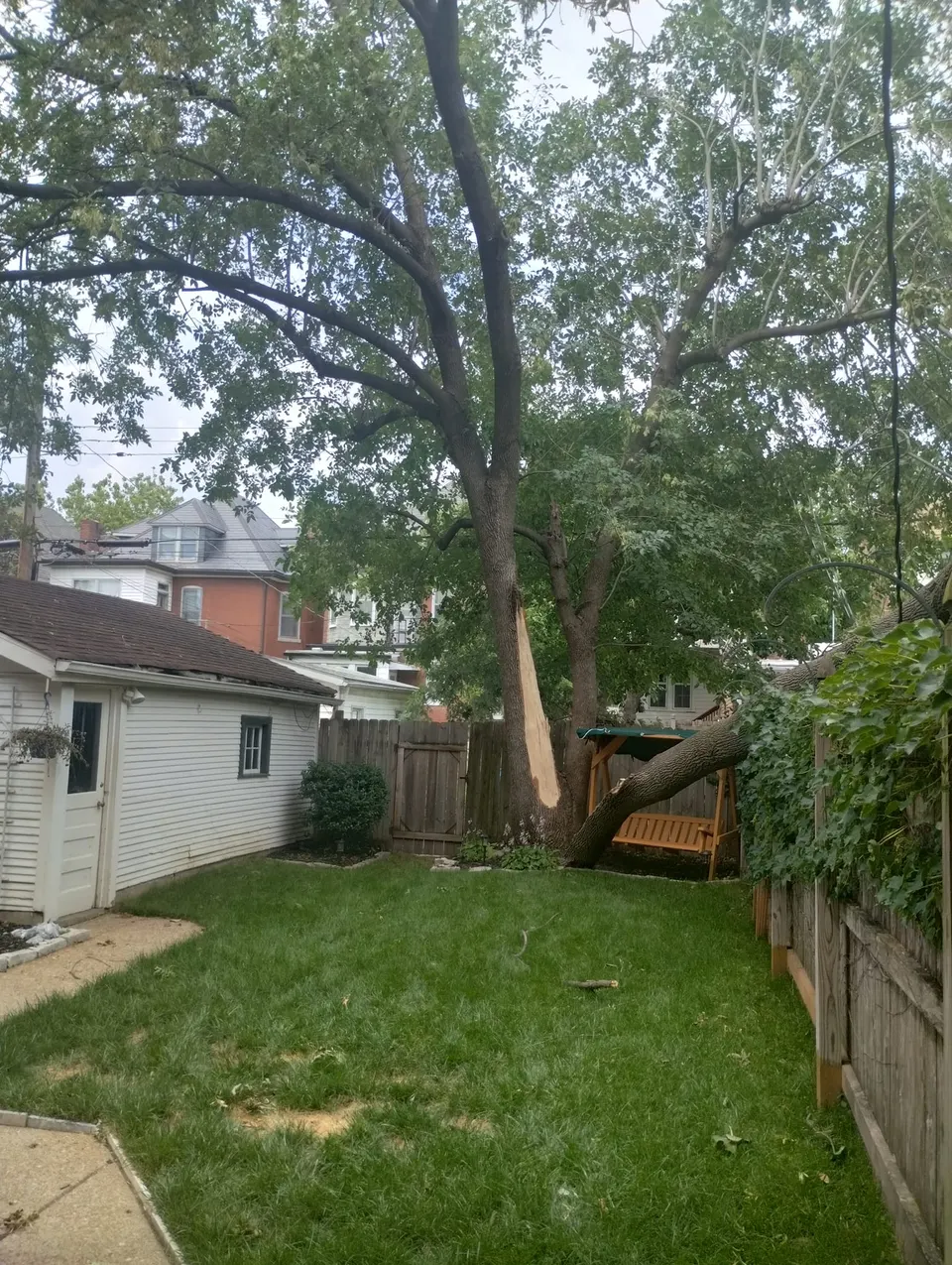
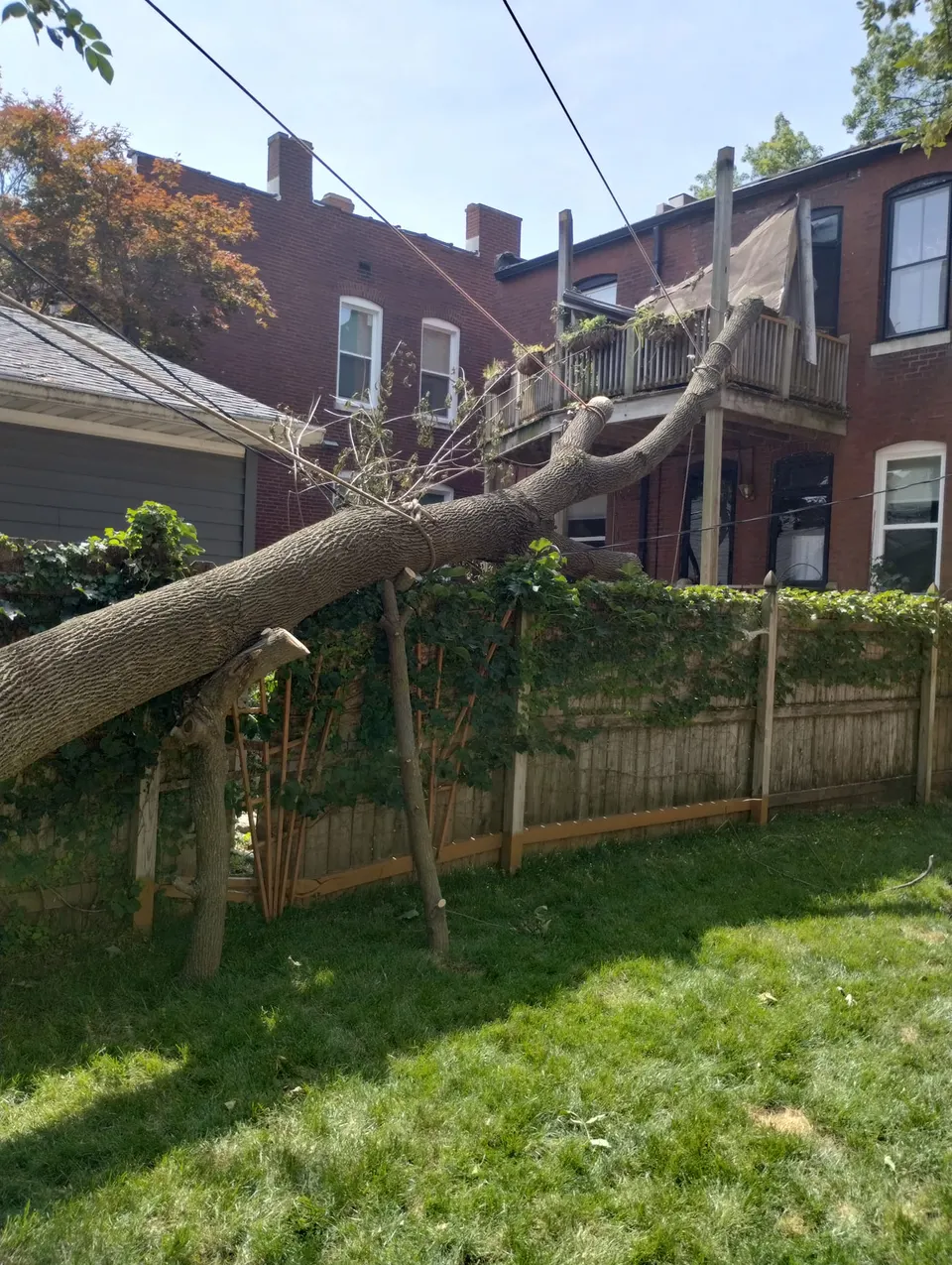
When a mature Bradford pear fails, it rarely drops a single branch. The included-bark seam lets go and a limb the size of a small tree peels away, often taking a strip of trunk with it and landing on whatever is beneath: a fence, a car, a roofline, or the neighbor's yard. The remaining trunk is left with an open wound and one or two more weak unions waiting for the next storm.
If that has just happened to you, our storm damage response guide walks through the first steps, and our 24/7 emergency tree service handles the removal. Whether your policy pays depends on what the tree hit: a split pear on the roof or fence is generally a covered claim, a split pear lying in the grass usually is not. Our article on insurance coverage for tree removal in Missouri explains the difference and how to document it.
One thing to know in advance: a Bradford pear that has partly split should not be "trimmed back to the good side" and left standing. The remaining unions carry the same defect, and the tree now has a large decay entry point. Removal is almost always the right call.
Can you save a Bradford pear with cabling and bracing?
Cabling and bracing installs steel cables high in the canopy, and sometimes threaded rods through the trunk, to keep weak unions from spreading apart under load. On a valued tree with one questionable union, it is a legitimate way to buy years of service. On a Bradford pear, it is a harder sell. The tree typically has several included-bark unions, not one, and the hardware does nothing to fix the bark trapped inside them. Cabling can make sense for a large, well-placed pear that provides significant shade and has not yet shown cracks, provided the owner accepts that it is a delay, not a cure. For a young or already-cracked pear, the money is better spent on removal and a replacement that will outlive the mortgage.
What does it cost to remove a Bradford pear in St. Louis?
Good news: pears are one of the less expensive trees to remove. Most top out at 30 to 40 feet with a moderate trunk diameter, so they fall toward the low end of the typical St. Louis-area tree removal range of $300-$2,500. The price climbs when the tree is close to the house, tangled in service lines, or already split with limbs resting on a structure, because each section has to be roped and lowered rather than dropped.
Plan on grinding the stump. Callery pear stumps and roots resprout with real enthusiasm, and the sprouts come back as the thorny wild form, not the ornamental. Our stump grinding cost guide covers pricing, but typical St. Louis-area stump grinding runs $100-$400 and is cheapest when bundled with the tree removal on the same visit. Any sprouts that appear from remaining roots in the first year can simply be cut and painted with a brush-killer, or mowed until they give up.
Thompson Tree Care and Landscaping has removed hundreds of trees across St. Louis, Kirkwood, Chesterfield, Florissant, O'Fallon, and Belleville since 2014. We are licensed and insured, estimates are free, and senior and veteran discounts apply. Call (314) 712-3035 or request an estimate online and we will quote the removal, the stump grinding, and the cleanup in one written price.
What should you plant instead of a Bradford pear?
The Bradford's appeal was spring flowers, fast growth, and a manageable size. Several Missouri natives deliver the same things without the split trunk or the invasive seedlings:
- Serviceberry (Amelanchier) — White flowers in early spring, edible June berries the birds love, and orange-red fall color. 15-25 feet.
- Eastern redbud — Magenta-pink flowers along bare branches in April, heart-shaped leaves, and a graceful form. 20-30 feet.
- American hornbeam (musclewood) — Tough, shade-tolerant, with smooth sinewy bark and strong branch structure. 20-35 feet.
- Blackgum (Nyssa sylvatica) — The best scarlet fall color of any native tree, and a sturdy, long-lived structure. 30-50 feet.
- White fringetree — Fragrant, fringe-like white flowers in May, small stature, and no serious pests. 12-20 feet.
Plant the replacement a few feet from the ground stump, water it deeply through its first two summers, and you will have a tree that is still standing when the last Bradford pear on the block is a memory.
Frequently Asked Questions
Bradford pears have tight, V-shaped branch unions with included bark, so the trunk splits apart in wind and ice storms, usually between 15 and 25 years of age. They also cross-pollinate with other Callery pear cultivars and spread thorny invasive seedlings across Missouri fields and roadsides, their blooms smell bad, and they are prone to fire blight.
Not yet for homeowners, but Missouri passed a law in 2024 that phases out nursery sales of Callery pear, including the Bradford cultivar, by 2029. You can still own and keep one, though most St. Louis arborists recommend replacing them with native species before they split.
Most Bradford pears are small to medium trees, so removal in the St. Louis area typically lands toward the low end of the $300-$2,500 tree removal range, with stump grinding adding roughly $100-$400. Trees that have already split over a house, fence, or driveway cost more because the crew has to rig each piece down safely. Thompson Tree Care provides free on-site estimates.
Yes. Callery pear stumps and roots resprout aggressively, and the sprouts revert to the thorny wild form. Grinding the stump 6-12 inches below grade removes the crown that produces new shoots and lets you replant the spot with a native tree within a season.