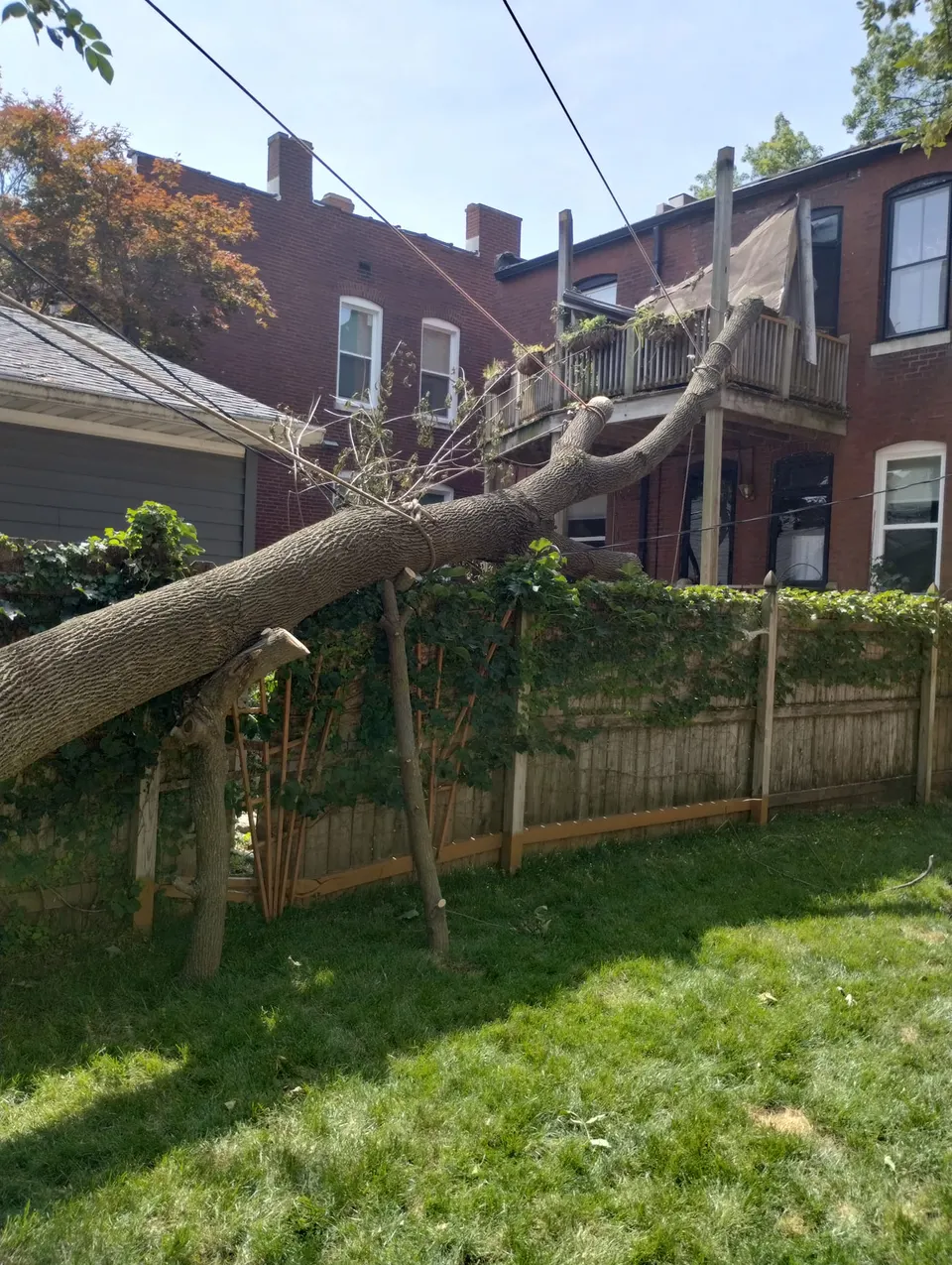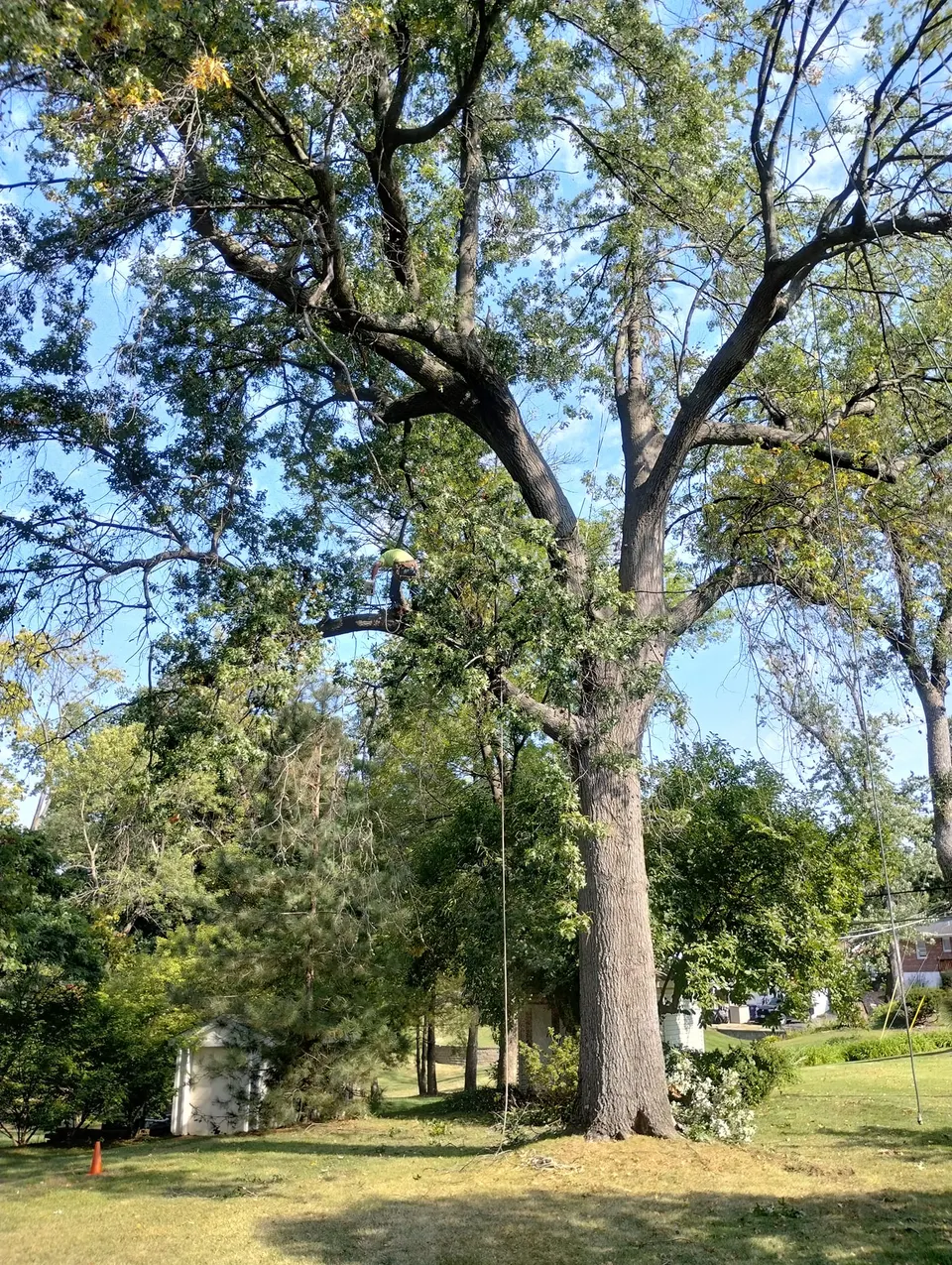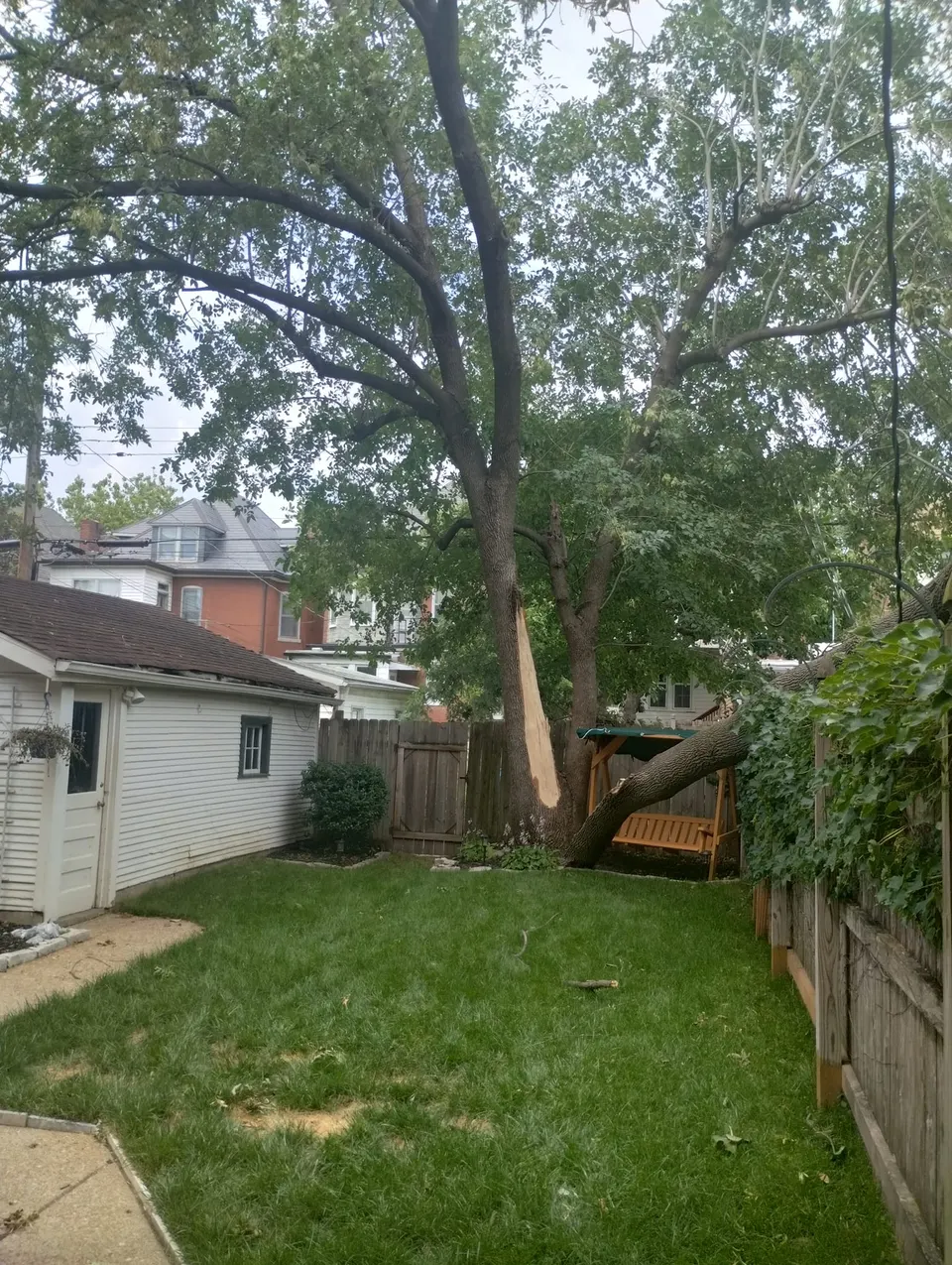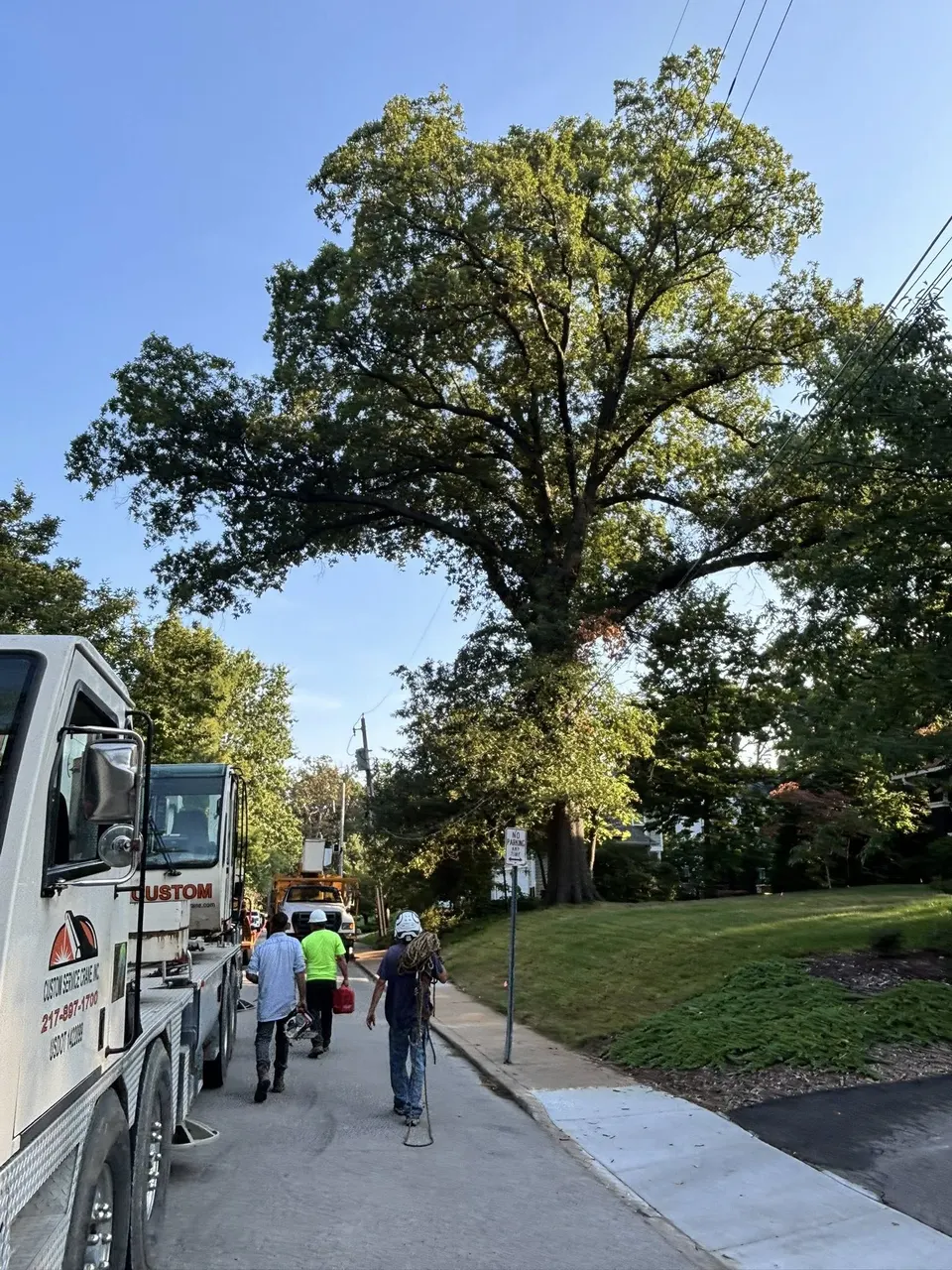
Oaks are the backbone of the St. Louis canopy. Pin oaks line the streets of Kirkwood and Webster Groves, white oaks anchor older lots in Chesterfield and Florissant, and nearly every mature neighborhood has a red or black oak that has been shading the same yard for eighty years. That is exactly why oak wilt matters here: a disease that can kill a pin oak in a single summer, then walk underground to the next one, is the most serious threat most St. Louis oak owners will ever face. Thompson Tree Care and Landscaping has assessed and removed oaks across the metro since 2014, and this guide explains how to recognize oak wilt, why pruning timing is the single most important thing you control, what treatment can and cannot do, and when an infected oak has to come down.
What is oak wilt?
Oak wilt is caused by the fungus Bretziella fagacearum (formerly classified as Ceratocystis fagacearum). Once it enters a tree, the fungus grows inside the water-conducting tissue just beneath the bark. The tree responds by plugging its own vessels to wall the fungus off, and that defense is what actually kills it: water can no longer reach the leaves, so the crown wilts even when the soil is soaking wet.
The disease has been confirmed across much of Missouri, including counties around St. Louis, and it behaves very differently depending on which oak it lands in. Oaks fall into two groups, and knowing which group your tree belongs to tells you how much time you have:
- Red oak group (pointed, bristle-tipped leaf lobes): pin oak, northern red oak, black oak, shingle oak, scarlet oak. These die quickly and there is no saving a symptomatic tree.
- White oak group (rounded leaf lobes): white oak, bur oak, swamp white oak, post oak, chinkapin oak. These resist the fungus and decline slowly, sometimes over many years, and are the only oaks where treatment of an infected tree is realistic.
What are the symptoms of oak wilt?
"Oak tree leaves turning brown in July" is the phone call that starts most oak wilt diagnoses. The exact pattern depends on the oak group.
Red Oaks: Fast and Dramatic
- Wilting begins at the top of the crown and the outer branch tips, then spreads inward and downward within days.
- Leaves turn bronze or dull brown starting at the margins and working toward the midrib, often leaving a green center on a browning leaf.
- The tree drops leaves while they are still partly green, a hallmark that separates oak wilt from drought, which usually browns leaves fully before they fall.
- A red oak can lose its entire crown in three to six weeks and almost never survives the season it is infected.
- The following spring, spore-producing fungal mats may form under the bark of the dead tree, causing raised, cracked patches that smell faintly of fruit. Those mats are what beetles carry to healthy oaks.
White and Bur Oaks: Slow and Easy to Miss
- One branch or one section of the crown browns and dies while the rest looks healthy.
- The pattern repeats year after year, with the tree losing a few more limbs each season.
- Decline can stretch over three to ten years, and some white oaks stall the disease on their own.
- Because the symptoms mimic ordinary dieback, white oak infections are often only confirmed when a neighboring red oak dies quickly.
If you see browning that fits either pattern, do not wait for fall to "see what it does." Get the tree assessed while a sample can still be taken for lab confirmation.
How does oak wilt spread?
Oak wilt moves two ways, and both explain the rules that follow.
Above ground, by beetles. Small sap-feeding beetles (nitidulids, often called picnic beetles) feed on the fungal mats under the bark of trees killed the previous year. They pick up spores and are drawn to fresh wounds on healthy oaks, where sap is flowing. A pruning cut, a limb torn off in a storm, or damage from a mower or construction equipment made in spring or early summer is an open invitation. The beetles are most active from roughly April through July, and a fresh wound is attractive to them for only a few days, which is why timing matters so much.
Below ground, through root grafts. Oaks of the same group growing within about 50 feet of each other frequently fuse their roots together. Once one tree is infected, the fungus travels through those shared roots to the next tree, and the next. This is why oak wilt so often shows up as a spreading pocket: one pin oak dies this year, the two beside it die the year after, and the row along the street follows. Root-graft spread accounts for most new infections in established neighborhoods, and it is the reason simply removing the dead tree is not always enough.
When should you trim oak trees in Missouri?
This is the one decision that prevents more oak wilt than anything else, and it is entirely in the homeowner's hands.
- Best window: November through February. The tree is dormant, the beetles are inactive, and the fungus is not producing spores. Every oak pruning job Thompson Tree Care schedules that can wait for winter, does. See our guide to the best time of year to trim trees in Missouri for how this fits with other species.
- Never prune oaks April through July. No shaping, no clearance cuts, no "just one limb." If a contractor offers to trim your oak in May, that is a reason to find a different contractor.
- Late summer and fall are acceptable when work cannot wait, since beetle activity drops off sharply after July, but winter is still preferred.
- Storm wounds are the exception. If a limb tears off an oak during a spring or summer storm, seal the wound immediately with pruning paint or latex paint. Arborists generally discourage wound dressings on trees, but oak wilt season is the one case where covering fresh wood right away is the correct move, because it hides the sap from beetles during the few days the wound is attractive.
Our tree trimming and pruning crews plan every oak job around this calendar, and we will tell you straight if a requested cut should wait until the tree goes dormant.
How is oak wilt treated?
Start with the hard truth: there is no cure for a red oak that is already showing symptoms. Injections, fertilizer, watering, and pruning out the brown limbs will not stop it. Treatment is about protecting the trees that are not yet infected and, in the case of white oaks, slowing a disease the tree is already resisting.
Fungicide Injection
Propiconazole injected into the trunk by a licensed pesticide applicator can protect healthy, high-value oaks within root-grafting distance of an infected tree, and can sometimes hold back the disease in a white or bur oak caught early. It is a preventive tool, not a rescue, and it must be repeated roughly every two years for as long as the threat remains. It does nothing for a symptomatic red oak. Thompson Tree Care does not apply pesticides ourselves; we assess and coordinate treatment with a licensed applicator when a tree is a good candidate.
Root-Graft Disruption
Because most neighborhood spread happens underground, the most effective containment is physically severing the roots between the infected oak and its neighbors, usually with a vibratory plow or trencher cutting a line at least four to five feet deep between the trees. This should be done before the infected tree is removed, since cutting the dying tree first can push the fungus outward through the grafts. Utility locating (811) is required before any trenching.
Prompt Removal and Proper Disposal
Infected red oaks should be removed as soon as the diagnosis is confirmed, ideally before the following spring when fungal mats form. The wood matters too: do not stack oak-wilt logs as firewood unless they are debarked or sealed under plastic through the next summer, and never move oak firewood to other properties. Chipping the brush is fine; the fungus does not survive well in chips. Our certified arborist assessment covers diagnosis, containment planning, and the removal itself.
What else looks like oak wilt?
Several common St. Louis oak problems produce brown leaves in summer, and treating the wrong one wastes money while the real cause advances. The usual suspects:
- Drought and heat stress — Leaves scorch at the margins but brown fully before dropping, and the whole tree is affected evenly rather than top-down. Common in August after a dry July.
- Anthracnose — A leaf fungus that causes brown blotches along the veins and early leaf drop, mostly on the lower, shaded crown in wet springs. Ugly but rarely fatal.
- Two-lined chestnut borer — A beetle that attacks stressed oaks; the crown dies from the top down over two or three years, with D-shaped exit holes in the bark.
- Bacterial leaf scorch — Browning from the leaf edge with a yellow band between brown and green tissue, showing up late summer and worsening each year.
Because oak wilt in red oaks is a removal sentence and most of these look-alikes are not, confirmation is worth the wait. A branch sample sent through the University of Missouri Extension plant diagnostic clinic or the Missouri Department of Conservation can verify the fungus. Our field guide to common tree diseases and pests in St. Louis covers each of these conditions in more detail.
What does removing an oak with oak wilt cost?
Typical St. Louis-area tree removal runs $300-$2,500 or more, and mature oaks usually land at the high end. A 70-foot pin oak over a roof, a fence, or a neighbor's driveway requires sectional rigging and often a crane or bucket truck, which is why our large tree removal crew handles most oak wilt jobs.
Speed saves money here. A red oak removed the season it dies can still be climbed and dismantled normally. Leave it standing a year and the wood turns brittle, limbs begin dropping on their own, and the job becomes a dangerous tree removal that has to be done from a lift with no climber in the tree. That is slower, costs more, and in the meantime the fungal mats under the bark are seeding every oak downwind.
Thompson Tree Care and Landscaping is licensed and insured, has completed more than 500 jobs across St. Louis, Kirkwood, Chesterfield, Florissant, O'Fallon, and Belleville since 2014, and holds a 4.8-star Google rating from 60+ reviews. Estimates are free, and we offer senior and veteran discounts. If an oak on your property is browning out of season, call (314) 712-3035 or request an estimate online and we will look at it before the neighbors' oaks are next.
Frequently Asked Questions
A red-oak-group tree (pin, red, black, or shingle oak) that is already showing oak wilt symptoms cannot be saved; it should be removed promptly. White and bur oaks progress slowly and can sometimes be held in check with fungicide injections by a licensed applicator if caught early. Healthy oaks nearby can be protected preventively.
Prune oaks during the dormant season, roughly November through February. Avoid pruning oaks from April through July, when sap-feeding beetles that carry oak wilt spores are most active and fresh cuts are most attractive to them. If a storm wounds an oak in that window, seal the wound immediately with pruning paint.
Red oaks can go from the first browning leaves to a fully dead crown in as little as three to six weeks, and rarely survive the season they are infected. White oaks lose one branch at a time and may decline over several years. Untreated, the fungus also moves through root grafts to neighboring oaks of the same group.
Typical St. Louis-area removal runs $300-$2,500 or more, and mature oaks are usually at the high end because of their size and weight. Removing an infected red oak promptly is cheaper and safer than waiting: standing dead oaks become brittle within a season, which forces slower, more expensive removal methods. Thompson Tree Care estimates are free.