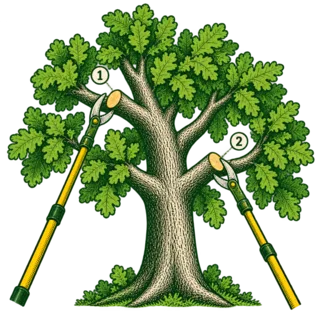
Tree Trimming & Pruning in St. Louis, MO
Keep your trees healthy, safe, and beautiful with professional tree trimming services from Thompson Tree Care. Our certified arborist team uses proven techniques to improve structure, promote growth, and prevent hazards.
- Licensed & Insured
- 24/7 Emergency
- Free Estimates

Why Is Tree Trimming Important for St. Louis Homeowners?
Tree trimming in St. Louis, MO is one of the most valuable investments you can make in your property's safety, appearance, and long-term value. Regular professional trimming keeps branches from growing into power lines, scraping against your roof, or hanging dangerously over walkways where they could fall and cause injury. Our crews trim across the metro, including Florissant and Chesterfield.
Beyond safety, properly trimmed trees are healthier trees. When our certified arborist removes dead, diseased, or crossing branches, the remaining canopy gets better airflow and sunlight, which reduces the risk of fungal infections and promotes strong new growth. Trees that receive regular trimming in the St. Louis climate tend to live longer, resist storm damage better, and look dramatically better than neglected trees.
Curb appeal matters too. A crown that has been thinned and shaped with proper cuts looks the part, without the stubs and water sprouts that follow topping. Whether you are preparing to sell your home in Kirkwood or simply want your Chesterfield yard to look its best, Thompson Tree Care delivers trimming results that make a visible difference.

What Types of Pruning Do We Offer?
Not all trimming is the same. Different situations call for different techniques, and knowing the difference is what separates a certified arborist service from someone with a chainsaw and a ladder. At Thompson Tree Care, we provide these specialized pruning services throughout St. Louis, MO:
Crown Thinning
Selective removal of interior branches to reduce density, improve light penetration, and allow better air circulation through the canopy. This reduces wind resistance and lowers the risk of storm damage, which is critical during St. Louis tornado season.
Crown Raising
Removing lower branches to increase clearance over sidewalks, driveways, roads, and structures. This is especially common for street trees and properties where low-hanging branches interfere with foot traffic or vehicle access.
Crown Reduction
Reducing the overall size of a tree's canopy by cutting branches back to lateral limbs. This is the correct way to reduce a tree's height or spread without topping, which damages tree health. Our arborist uses proper pruning cuts that promote healing. Here is why tree topping does more harm than good.
Deadwooding
Targeted removal of dead, dying, and broken branches from the canopy. Dead branches are a liability because they can fall without warning. This service is essential for trees near homes, driveways, and play areas.
How Does a Trimming Job Go?
Thompson Tree Care and Landscaping trims in four steps: agree on the goal, check the season, make the cuts the right way, and clean up. The written estimate names the trees and the cuts before anyone climbs.
-
1
Walk-Through & Goals
The estimate starts with what you want: clearance from the roof or the driveway, deadwood out of an old oak, a limb off the neighbor's garage, or a crown that has outgrown the yard. The written estimate names the trees and the cuts, so there is no surprise about how much comes off.
-
2
Timing Check
Dead, broken and hazardous limbs come off any time of year. Routine pruning waits for the right season: oaks are pruned in dormancy and never from April through July, when the beetles that spread oak wilt are active. Most other shade trees are easiest to shape in late winter, when the structure shows.
-
3
The Cuts
Limbs are removed at the branch collar, not flush with the trunk and not left as a stub. A reduction cut goes back to a lateral branch large enough to take over, which is the difference between reduction and topping. Work is done from the bucket truck where it reaches and by rope where it does not.
-
4
Cleanup
Brush is chipped and hauled, or the limbs are cut to length if you want the firewood, and the lawn is raked before the crew leaves. Ask for the chips if you want mulch for the beds.
What Affects the Price of Tree Trimming in St. Louis?
Trimming is priced on time in the tree, and six things drive that time: the size of the tree and how much comes off, how many trees are on the visit, what the limbs hang over, whether the bucket truck can reach, what wires are involved, and whether a street-tree permit is needed. All six are checked on the free on-site estimate.
1. Size of the tree and how much comes off
Deadwooding a 70-foot oak means reaching every dead limb in the crown; raising a 25-foot maple over a sidewalk is a few cuts from the ground. Crown reduction is the slowest work, because each cut is placed at a lateral branch rather than at a convenient height.
2. How many trees
The truck, chipper and crew set up once, so a second and third tree on the same visit cost less each than three separate trips. If several trees need attention, have them quoted together.
3. What the limbs hang over
A limb over open lawn is cut and dropped. A limb over the roof, a fence, a carport or the neighbor's yard is roped and lowered, or cut in short pieces, which takes longer.
4. Access for the bucket truck
Where the bucket truck reaches the tree from the driveway or the street, the work goes fast. Back-yard trees behind a fence or down a gangway are climbed, and the brush is dragged out by hand.
5. Wires
Only qualified line-clearance contractors may work within 10 feet of Ameren Missouri's higher-voltage lines. The service drop to your house is the homeowner's responsibility, and Ameren can disconnect it by appointment so the limbs around it can be pruned. Ameren itself trims only in its rights-of-way and easements.
6. Permits for street trees
In the City of St. Louis the tree between the curb and the sidewalk is a City tree, and code 22.48.110 requires a Forestry permit even to prune it. In most county municipalities the street tree sits on the lot and is the owner's to maintain. Where a permit is needed, the time to get it goes into the schedule.
For typical St. Louis trimming price ranges, read Tree Trimming Cost in St. Louis: 2026 Price Guide. The exact number is the written estimate after the walk-through.
When Is the Best Time to Trim Trees in St. Louis?
In the St. Louis, MO climate, the ideal window for most tree trimming is late winter through early spring, roughly February through March. During this dormant period, trees are not actively growing, which means less stress from pruning cuts, better visibility of the branch structure without leaves, and lower risk of spreading certain diseases like oak wilt.
That said, some trimming can and should be done year-round. Dead or hazardous branches do not wait for a convenient season. If you have a limb hanging over your roof or rubbing against your house, call us at (314) 712-3035 and we will take care of it regardless of the time of year. For emergency situations involving dangerous branches, we offer 24/7 response.
The Certified Arborist Advantage
Anyone can cut a branch, but improper trimming causes real harm. Topping, lion-tailing, and flush cuts are common mistakes made by unqualified tree services that leave trees weakened and susceptible to disease. Thompson Tree Care employs a certified arborist who follows International Society of Arboriculture (ISA) standards for every pruning cut. This means your trees are trimmed correctly, promoting natural healing and maintaining structural integrity for years to come.
Last Updated: October 2026
Questions St. Louis Homeowners Ask Before a Trim
Straight answers to the questions that come up on the phone and at the estimate, written out in full rather than tucked into a drop-down.
Can you prune my oak this month?
If it is between April and July, only for a hazard. Arborists in Missouri avoid pruning oaks in spring and early summer because the sap-feeding beetles that carry oak wilt are drawn to fresh cuts. Routine oak pruning is scheduled for the dormant season, roughly November through February, and a storm wound in the risky window gets sealed right away. Details are in the oak wilt guide.
The limb is over the power line to my house. Can you cut it?
The line from the pole to your house is the service drop, and Ameren Missouri says trees around it are the property owner's responsibility. Ameren can disconnect the drop by appointment so the limb can be pruned safely, then reconnect it. Limbs within 10 feet of the higher-voltage lines along the street or alley are different: only qualified line-clearance contractors may work there, so that call goes to Ameren. Never cut a limb that is touching a wire.
Can you trim the tree between my sidewalk and the street?
In the City of St. Louis, not without a permit. That strip is City property, the Forestry Division maintains the trees in it, and city code 22.48.110 requires a permit to prune, spray or remove one. Report a problem street tree to the Citizens' Service Bureau at 314-622-4800. In most St. Louis County municipalities the required street tree sits on the lot in front of the setback line and is yours to maintain, though some cities, such as Kirkwood and Ladue, regulate trees in the right-of-way. Ask at the estimate.
How much can come off at once?
Less than most people expect. A common arborist rule of thumb is to remove no more than about a quarter of the live crown in one season, and a mature tree tolerates less. Taking more forces the tree to push water sprouts and leaves wounds that do not close, which is why topping is never offered; see why tree topping does more harm than good. If the tree is simply too big for the spot, crown reduction or removal is the honest conversation.
Do my trees need trimming every year?
Most mature shade trees do not. Fast-growing silver maples and sweetgums, fruit trees and anything hanging over a roof need a look more often than a slow-growing oak in open lawn. Young trees are the exception: a few small structural cuts in their first years prevent the large, expensive ones later. The best time of year to trim trees in Missouri covers the calendar.
My tree has yellow leaves or dead branches on one side. Is that a trimming job?
Not until the cause is known. Yellowing between the veins on a pin oak is usually iron chlorosis from the alkaline soils around St. Louis; dieback on one side can be a root problem or a disease. Pruning the symptom does not fix either. An arborist visit sorts out which trees need cuts and which need treatment or removal; start with pin oak yellow leaves and common tree diseases and pests in St. Louis.
Frequently Asked Questions About Tree Trimming
Most trees in St. Louis should be trimmed every 3 to 5 years for ongoing health and structure. Fast-growing species like silver maples or sweetgums may need attention every 2 to 3 years. Fruit trees benefit from annual pruning. Our certified arborist can assess your specific trees and recommend the ideal trimming schedule.
Late winter to early spring (February through March) is generally the best time to trim most trees in the St. Louis area, as trees are dormant and it is easier to see the branch structure. However, dead or hazardous branches can and should be removed any time of year. Oaks are the exception: they are pruned in the dormant season and never from April through July, when the beetles that spread oak wilt are active.
Tree trimming typically refers to cutting back overgrown branches to maintain shape and clearance, while pruning is a more targeted practice focused on tree health — removing dead, diseased, or crossing branches. In practice, professional tree care like what Thompson Tree Care provides combines both approaches for the best results.
Tree trimming in St. Louis generally costs between $200 and $1,200 depending on the size of the tree, number of trees, and complexity of the work. Small trees may cost $200–$400, while large mature trees can be $800–$1,500+. Thompson Tree Care provides free on-site estimates with transparent pricing. The factors behind those ranges are listed under what affects the price.
Other Services You May Need

Tree Removal
- Safe removal of any size tree
- Hazardous tree specialists
- Complete cleanup & hauling

Certified Arborist
- Tree health assessments
- Disease diagnosis & treatment
- Expert planting recommendations

Tree Cabling & Bracing
- Split trunk stabilization
- Support for heavy limbs
- Preserve valuable mature trees