A shelf of tan brackets at the base of the big oak, a cluster of honey-colored mushrooms popping up against the trunk after a wet week in October, a hard woody knob growing out of the bark ten feet up: St. Louis homeowners send Thompson Tree Care and Landscaping photos like these every fall. The instinct is to ask what to spray. The honest answer is that the mushroom is not the problem. It is the visible tip of a fungus that has been working inside the tree for years, and the only question that matters is whether the tree is still sound enough to stand. This guide explains what each kind of growth means, why fungicides do not fix it, how an arborist judges a hollow or decayed tree, and when the safe move is removal.
What does it mean when mushrooms grow on a tree?
A mushroom, conk, or bracket is a fruiting body, the reproductive part of a fungus. The organism itself is a network of threads (mycelium) spread through whatever the fungus is eating. When it fruits on a living tree, the wood it is eating is the tree's own trunk or roots, and by the time a fungus has enough stored energy to produce mushrooms, it has usually been decaying that wood for several years.
That is why arborists treat fungal growth on a trunk or root flare as evidence of established decay, not as an early warning. The size of the mushroom tells you nothing about the size of the problem underneath; a conk the size of a dinner plate and a conk the size of a quarter can both sit on top of a hollow. Location matters far more than size. Growth at the root flare and on major roots points to root or butt rot, which threatens the whole tree's anchoring. Growth on the trunk points to heart rot, which weakens the stem. Growth on a single limb usually means that limb is dying.
Decay itself is not always an emergency. Many mature trees carry some rot for decades. It becomes a safety issue when the remaining sound wood gets too thin to hold the tree up, and fungal fruiting is often the first outward sign that the balance has shifted.
Which growths do St. Louis homeowners see, and what does each signal?
Not every growth on a tree is a decay fungus, and some that look alarming are harmless. The common ones around St. Louis, roughly from most to least serious:
- Shelf or bracket conks at the base (Ganoderma and similar). Hard, woody, often reddish-brown on top with a white underside, growing out of the root flare or the lowest few feet of trunk. This is the classic sign of butt rot and root rot, the decay that undermines the tree's anchor. Conks at the base of an oak, maple, or hackberry near a house are the highest-priority finding on this list.
- Clusters of honey-colored mushrooms at the base in fall (Armillaria). Honey mushrooms appear in tight clumps at the trunk base or along roots after autumn rains, then vanish in a week or two. They indicate Armillaria root rot, which kills roots and can move to neighboring trees and shrubs through the soil. Pulling back bark at the base often reveals white fan-shaped mycelium.
- Bright orange or yellow shelves on the trunk (sulfur shelf, "chicken of the woods"). Common on old oaks and cherries. They signal heart rot in the trunk or a major limb. The tree may look full and green while the center is hollowing out.
- Turkey tail and other thin, colorful brackets. These grow on dead wood: stumps, fallen logs, dead limbs, and dead sections of a living trunk. On a live tree they tell you which part is already dead rather than causing new decay.
- Lichen and moss. Gray-green crusts and soft green mats on bark. Harmless. They use the bark as a surface, not as food. Heavy lichen on a thinning tree is a sign the canopy has opened up, not a cause of it.
- Slime flux or wetwood. A dark, wet streak running down the bark from a crack or wound, sometimes frothy and sour-smelling, often on elms, maples, and cottonwoods. It is bacterial, mostly cosmetic, and does not need treatment; do not drill "drain holes," which only add wounds.
- Sooty mold. A black film on bark, leaves, or whatever sits under the tree. It grows on the sugary honeydew dropped by aphids or scale insects feeding above, not on the tree itself. The fix is managing the insects, not the mold.
Our field guide to common tree diseases and pests in St. Louis covers the leaf and insect problems that often get confused with fungus; this article stays with decay.
Can you treat tree fungus?
Not in the way most people hope. Fungicides work on the surface of leaves and twigs; they do not penetrate wood, and decay fungi live deep inside the trunk and roots. Knocking the mushrooms off, scraping the conk away, or painting the spot removes the fruiting body and leaves the fungus exactly where it was. It will fruit again next season.
What you can do is stop making the tree's job harder, because a stressed tree walls off decay more slowly than a vigorous one:
- Pull mulch back from the trunk. A mulch "volcano" piled against the bark keeps the root flare wet and invites exactly the fungi described above. Mulch should be two to four inches deep and stop several inches short of the trunk.
- Protect the roots. Trenching, grade changes, parked vehicles, and new patios inside the drip line wound and suffocate roots, and wounded roots are the entry point for Armillaria and Ganoderma.
- Fix drainage. Standing water around the base after rain starves roots of oxygen. Redirect downspouts and correct low spots.
- Water in drought. Deep, infrequent soaking during the dry weeks of July and August keeps the tree's defenses working.
- Prune dead wood properly. Removing dead limbs with clean cuts at the branch collar limits the dead tissue decay fungi feed on. Our tree trimming and pruning crews handle this on mature trees where the dead wood is high and heavy.
There are a few narrow cases where a licensed applicator can help, such as protecting valuable trees nearby from Armillaria spread; Thompson Tree Care does not apply pesticides ourselves, but we assess and coordinate treatment with a licensed applicator when a tree is a good candidate. For the tree already carrying conks, the useful work is assessment, not chemistry.
How does an arborist decide if a hollow or decayed tree is safe?
A tree with internal decay is judged on two things: how much sound wood is left, and what it would hit if it failed. The assessment usually runs in this order:
- Visual inspection. Conks and their location, cavities, cracks, bark that is loose or sunken, a lean (especially a new one), soil heaving on the side opposite a lean, dead limbs, and thinning in the crown. Fungal conks on the root flare combined with any lean is the combination that moves a tree to the top of the priority list.
- Sounding. Tapping the trunk with a mallet. Solid wood rings; a hollow gives a dull, drum-like thud. It is a crude test, but it quickly maps how far a cavity extends.
- Resistance drilling. A fine probe measures how much resistance the wood gives as it advances, producing a profile of sound wood versus decay across the trunk. This is how an arborist measures the shell rather than guessing.
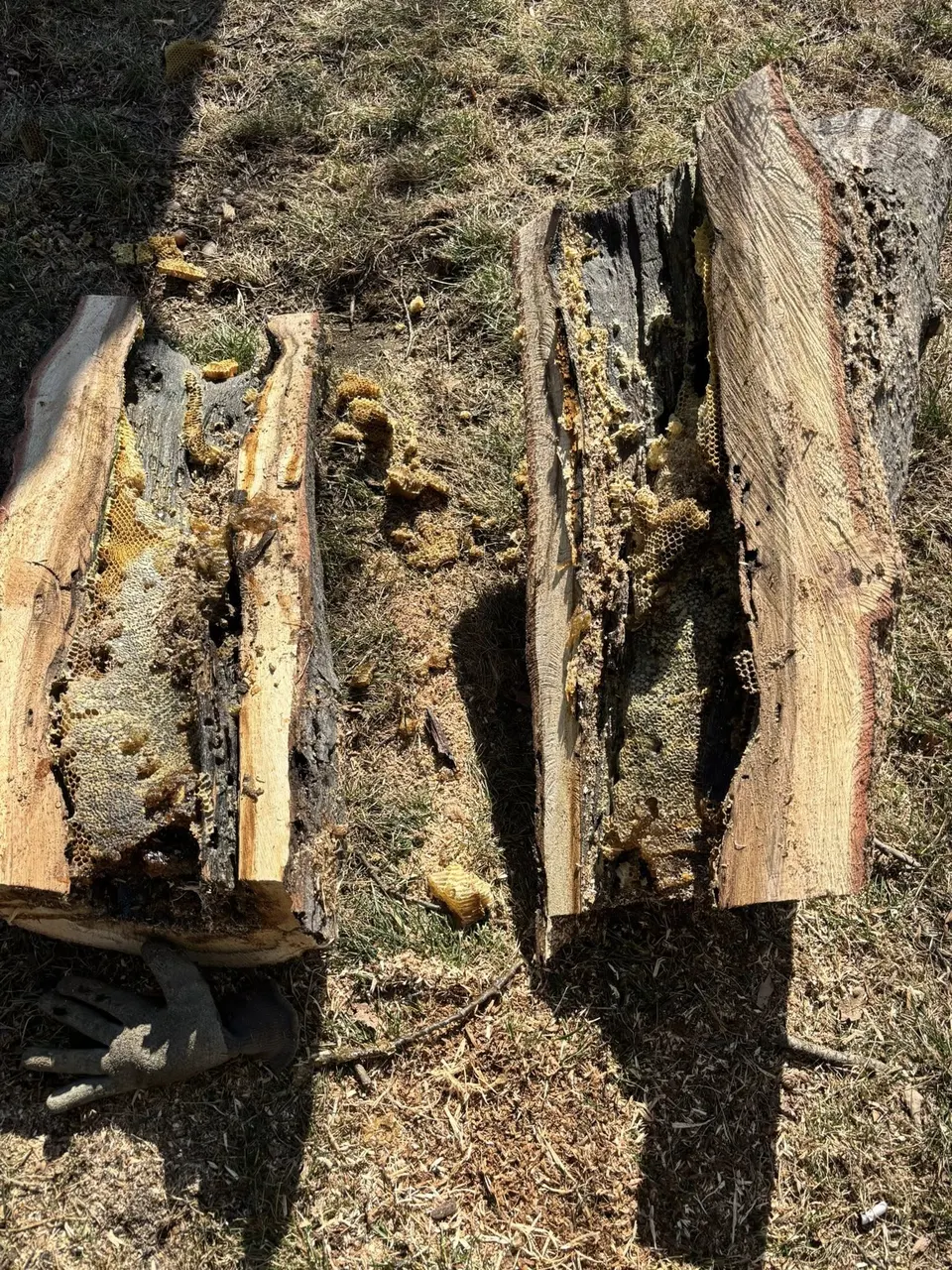
- The shell rule. A widely used guideline is that a trunk needs roughly one-third of its radius as solid wood to remain structurally sound. A 30-inch-diameter oak with five inches of sound shell around a hollow center is a different tree from one with two inches, even though they look identical from the yard.
- Targets. A hollow tree at the back of a two-acre lot can often be left alone or reduced. The same tree leaning toward a bedroom, a driveway, a sidewalk, or a play set cannot. Risk is always the tree's condition multiplied by what is under it.
If you are not sure how far along a tree is, our guide to the signs a tree is dead or dying walks through the checks you can do yourself before calling. A certified arborist assessment from Thompson Tree Care puts numbers on the shell and a plain recommendation on paper.
When should a fungus-decayed tree be removed?
Removal is the right call when the tree fails the assessment above: conks at the root flare, a thin shell, cracks or a lean, and a house, vehicle, or people within reach. A few specific situations tip the decision:
- Root or butt rot with a target. Decay at the base compromises the anchor, and trees with root rot tend to fail whole, at the ground, in wind or after saturating rain. No amount of crown work reduces that risk.
- A rotten base cannot be cabled. Cabling and bracing supports weak unions and heavy limbs in a tree whose trunk and roots are sound. Hardware installed above a decayed base only decides which direction the tree falls.
- Heart rot in a major limb over a structure. Sometimes the answer is removing that limb rather than the tree, if the trunk below is solid. That is an assessment call, not a guess from the ground.
- Armillaria near valued plantings. Removing the infected tree and grinding the stump takes away the food source the fungus uses to reach neighboring roots.
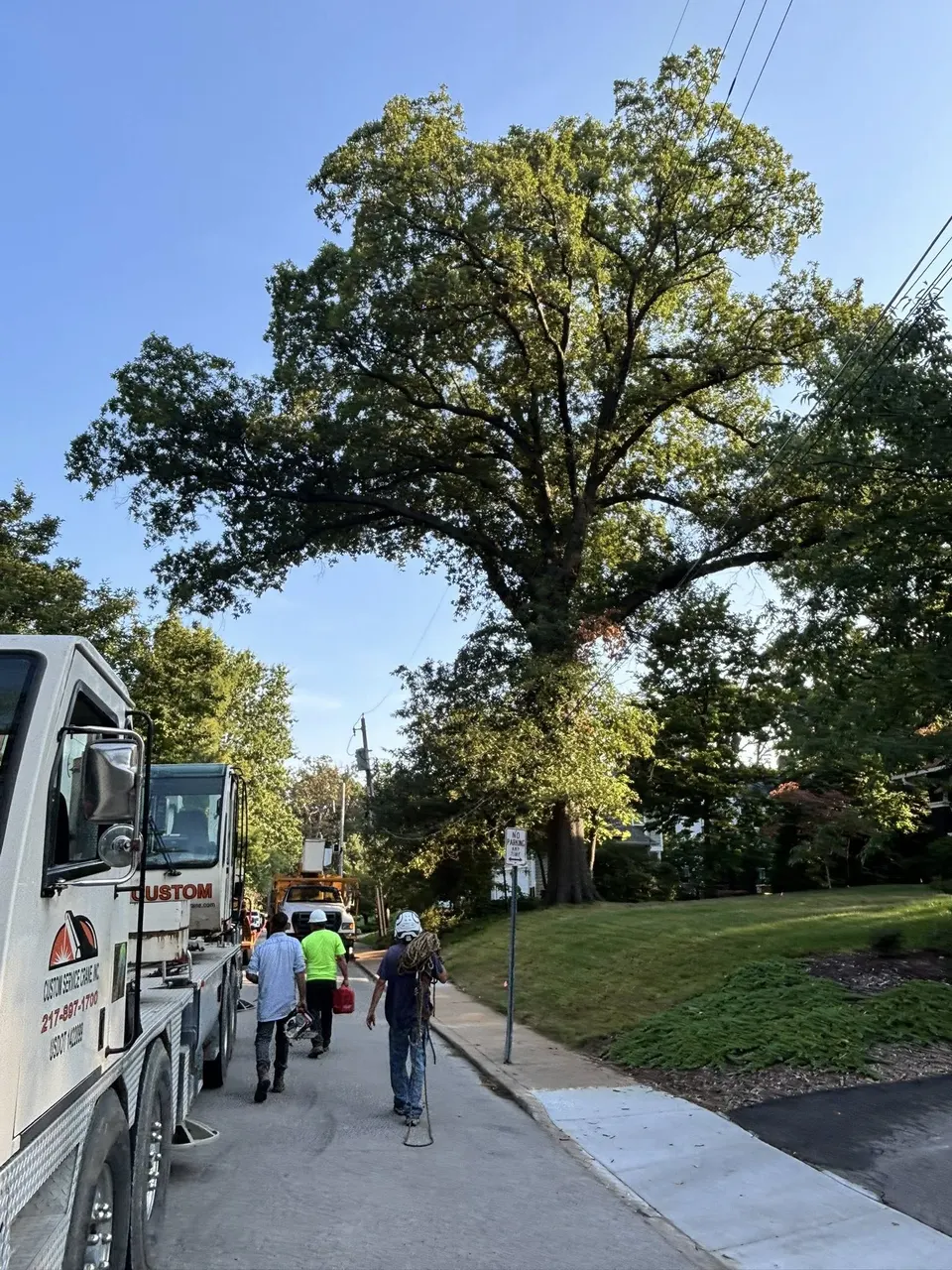
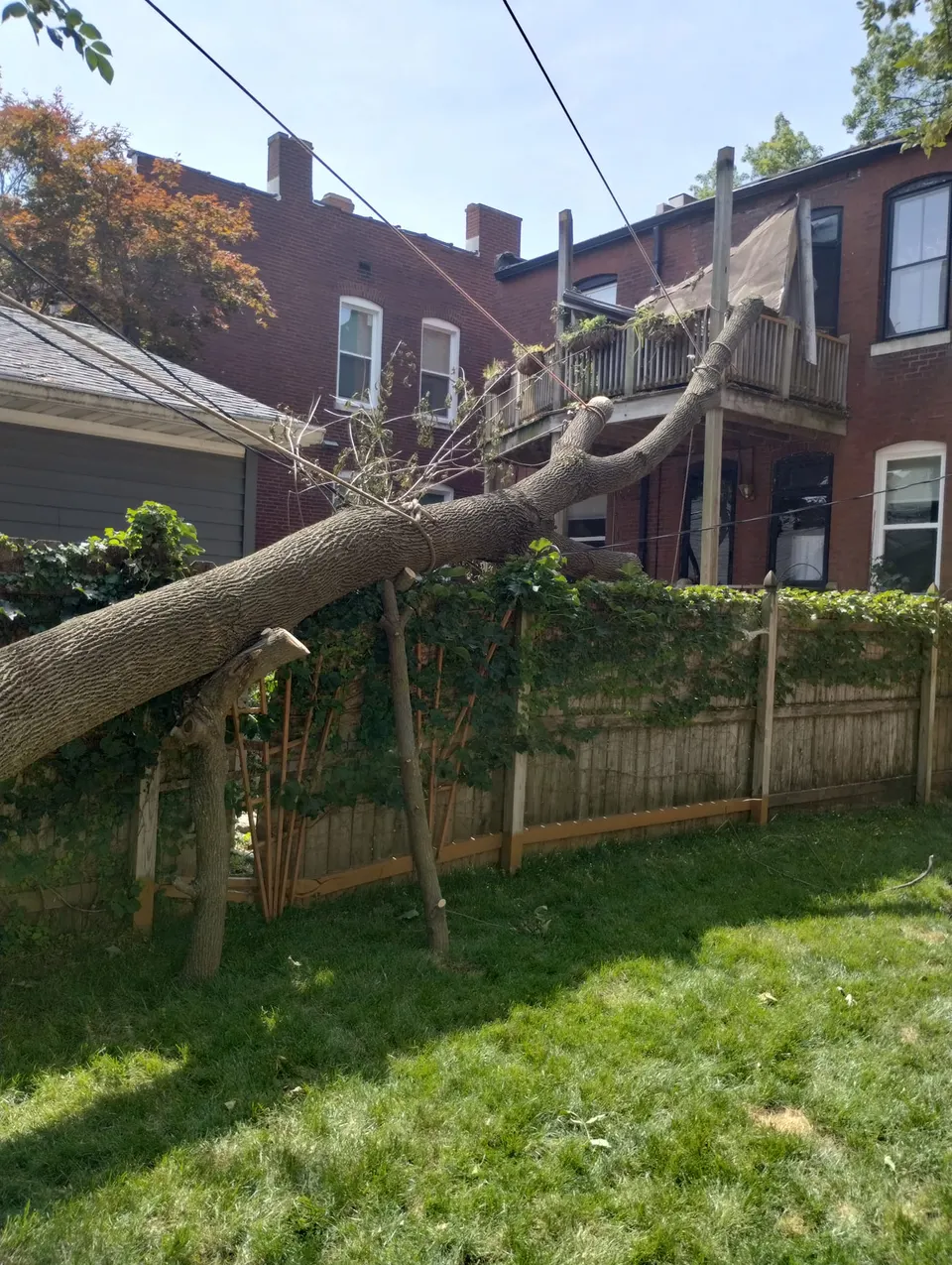
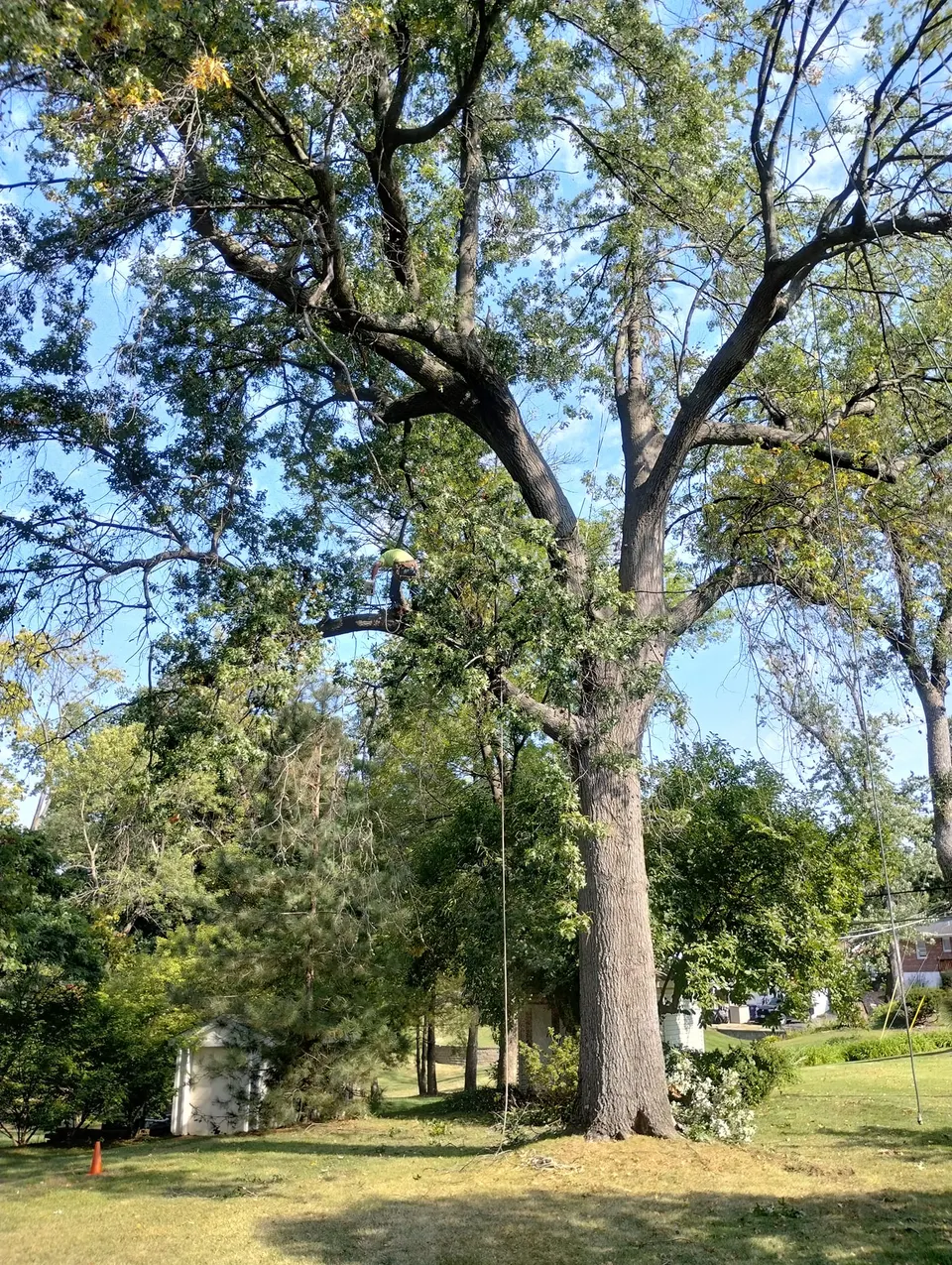
When a decayed tree is close to a home, the removal itself is different from a healthy-tree job: a rotten trunk cannot safely hold a climber, so the work is done from a bucket truck or with a crane, piece by piece. That is the dangerous tree removal work Thompson Tree Care crews are equipped for, and the reason we ask about fungus and cavities before quoting any tree removal.
What do removal and stump grinding cost for a decayed tree?
Typical St. Louis-area tree removal runs $300-$2,500 or more depending on size, location, and access. Decayed trees tend to land higher than healthy trees of the same size for one reason: the crew cannot climb them. Working from a lift or setting a crane takes more equipment and more time, and a large hollow oak beside a house is usually at the top of that range. Waiting rarely helps; a tree that is marginal this year is more brittle and more expensive next year.
Stump grinding typically adds $100-$400 per stump, and with a fungus-killed tree it is worth doing rather than leaving the stump. Grinding the stump and the major roots removes the wood Armillaria and Ganoderma keep feeding on, which matters if you plan to replant nearby. Our stump grinding crew can grind the stump the same day as the removal and haul the chips or leave them for backfill.
Thompson Tree Care and Landscaping is licensed and insured, has completed more than 500 jobs across St. Louis, Kirkwood, Chesterfield, Florissant, O'Fallon, and Belleville since 2014, and holds a 4.8-star Google rating from 60+ reviews. Estimates are free, and we offer senior and veteran discounts. If mushrooms or conks have shown up on a tree near your house, call (314) 712-3035 or request an estimate online and we will tell you honestly whether the tree can stay.
Frequently Asked Questions
Mushrooms or shelf fungus growing directly out of the trunk, the root flare, or the major roots almost always mean the fungus is already decaying wood inside the tree. Mushrooms growing in mulch, in the lawn a few feet away, or on an old stump are feeding on dead organic matter and are not a threat to a living tree. Lichen and moss on bark are harmless as well.
No fungicide reaches decay that is already inside the wood, and knocking the mushrooms off does nothing because the fungus lives in the trunk, not in the mushroom. What actually helps is reducing stress on the tree: keep mulch off the trunk, avoid wounding roots, fix poor drainage, and water in drought. The real question is whether the tree is still structurally sound, which takes an arborist assessment.
Not automatically. Trees can stand for decades with a hollow center as long as the outer shell of sound wood is thick enough. A common arborist guideline is that roughly one-third of the trunk radius should be solid wood. A hollow tree becomes dangerous when the shell is thin, when there are cracks or lean, when conks are growing at the root flare, or when the tree would hit a house, driveway, or play area if it failed.
Typical St. Louis-area removal runs $300-$2,500 or more, and decayed trees often cost more than healthy ones of the same size because a rotten trunk cannot be safely climbed, so the work is done from a bucket truck or crane. Stump grinding usually adds $100-$400 per stump. Thompson Tree Care estimates are free and job-specific.