Most St. Louis homeowners notice something is off long before a tree actually fails: a maple that leafs out weeks after the one next door, mushrooms at the base of an oak, a crack running down the trunk after a July thunderstorm. The hard part is knowing which of those clues mean "keep an eye on it" and which mean "call someone this week." This guide covers the eight signs a tree is dead or dying, the simple tests you can do yourself, and what happens next. If you already know the tree is dead and are weighing whether it should come down, our guide to deciding when to remove a tree picks up where this one leaves off.
How Do You Check If a Tree Is Dead?
Three quick checks answer the question for most trees, and none of them require tools beyond a thumbnail or a pocketknife:
- The scratch test. Pick a pencil-thick twig and scrape away a small patch of bark. Green, slightly moist tissue underneath means that branch is alive. Brown, dry tissue means it is dead. Repeat on four or five branches around the crown, because a tree can be dead on one side and alive on the other.
- The twig snap. Bend a small twig. A live twig flexes and tears; a dead twig snaps cleanly with a dry crack.
- The bud check. From late winter on, live trees carry plump buds along the twigs. Buds that are shriveled, black, or missing entirely point to dead wood. By late spring, a tree with no leaves while its neighbors are fully green has almost certainly died.
If those tests come back alive but the tree still looks wrong, keep reading. Dying trees fail slowly, and the signs below usually show up a season or two before the scratch test turns brown.
What Are the 8 Signs a Tree Is Dying?
Some of these signs are cosmetic on their own. Two or three together, especially on a large tree near a house, driveway, or power line, are the pattern arborists look for.
1. No leaves, or sparse and late leaf-out
Compare the tree with others of the same species on your street. A pin oak that is still bare in mid-May while every other pin oak is full is telling you something. Thin canopies, undersized leaves, and leaves that yellow and drop in July instead of October are the same message delivered more slowly. Late leaf-out on its own can follow a rough winter, but late leaf-out that gets worse each year is decline.
2. Brittle, bare branches and dead wood in the crown
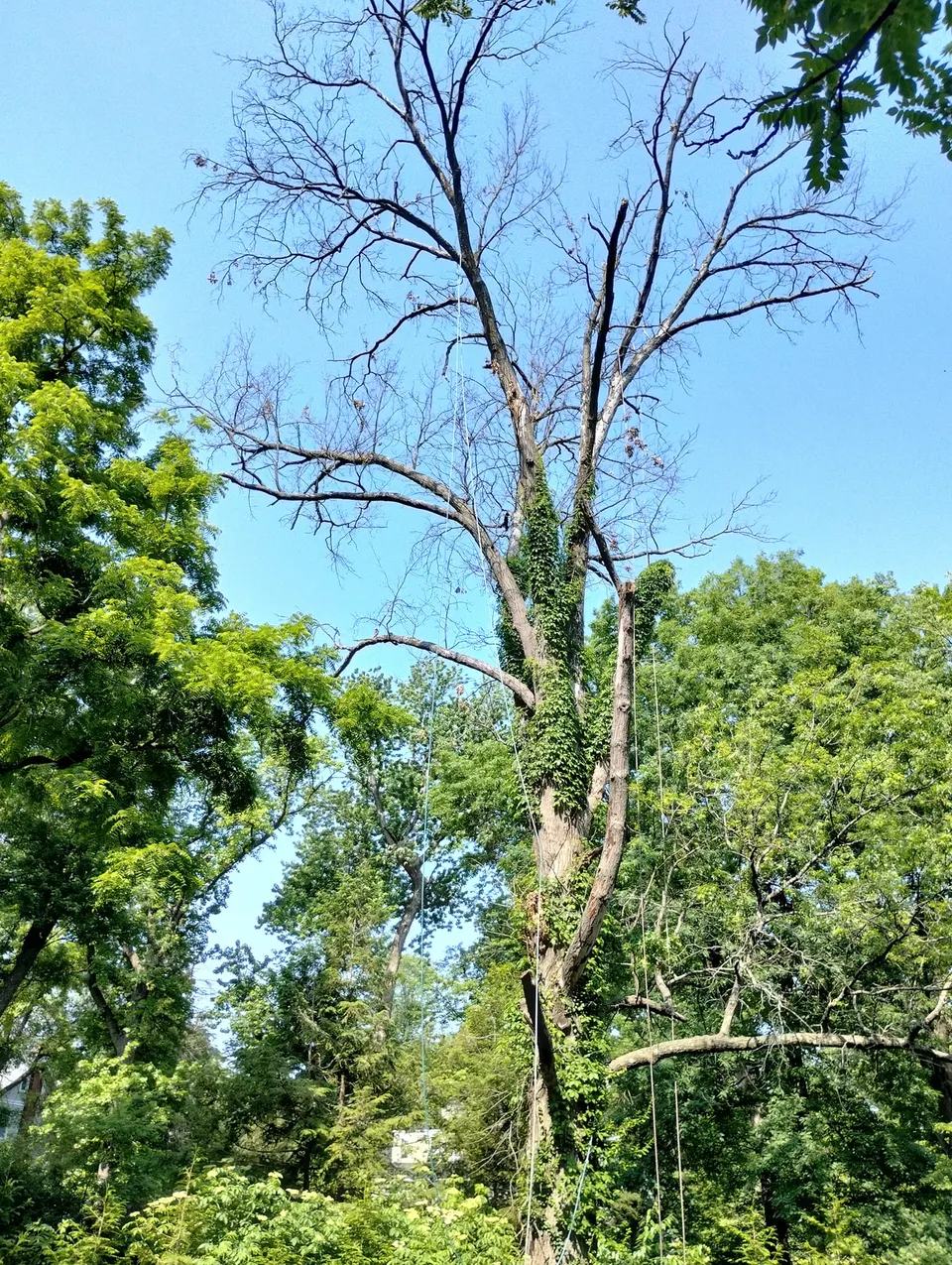
Run the scratch test on branches that never leafed out. Dead limbs scattered through an otherwise green crown are common and can simply be pruned. Dead wood concentrated at the top of the tree, or making up more than a third of the canopy, means the root system can no longer supply the whole tree. Large dead limbs are also the ones that come down in storms, which is why they earn the nickname "widowmakers."
3. Bark peeling, splitting, or falling off
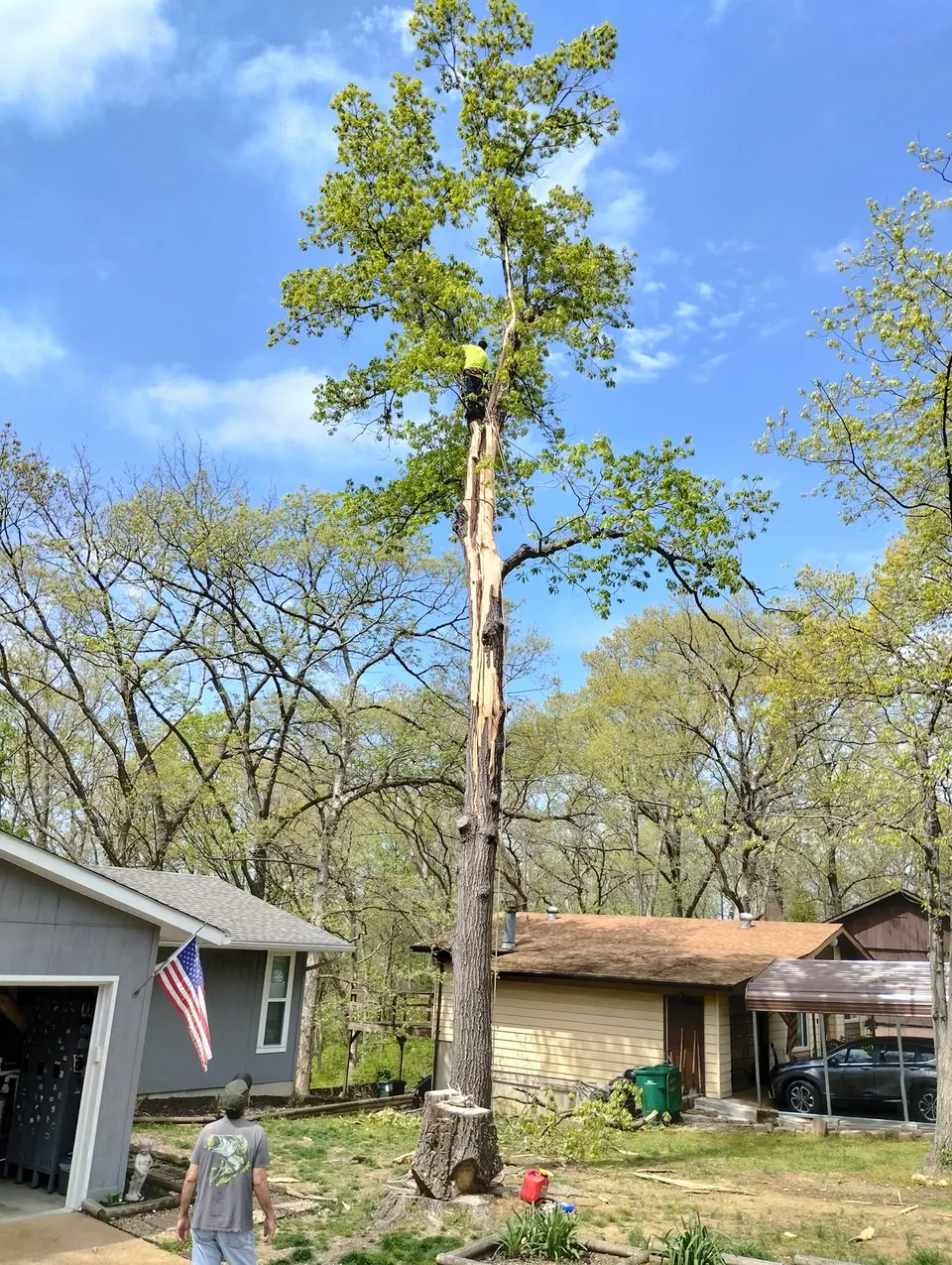
Healthy bark is firmly attached and, on most St. Louis species, renews itself gradually. Bark that slides off in sheets, exposes smooth bare wood, or has stopped growing over old wounds means the living tissue beneath it has died. Look closely at vertical cracks in the trunk too: a shallow frost crack on a young maple is minor, but a deep, cracked tree trunk that opens and closes in the wind, or one that runs from a branch union down toward the ground, is a structural failure in progress.
4. Mushrooms or fungus on the trunk or at the base
Mushrooms growing on a tree are the fruiting bodies of fungi that are already feeding on the wood inside. Shelf-like conks on the trunk mean heart rot in the upper stem. Clusters of mushrooms at the root flare, or in a ring around the base of the tree, usually mean root rot or butt rot, which is the most dangerous kind because it destroys the wood that anchors the tree. A tree with root rot can look green and full right up until the day it tips over, so this sign deserves a professional look even when the canopy seems fine.
5. Hollow trunk or large cavities
A hollow tree is not automatically a dead tree. The living, water-conducting tissue sits just under the bark, so a tree can leaf out normally with a trunk that is mostly empty. What a hollow trunk does change is strength. The tree has lost much of the wood that resists wind loading and the weight of its own crown, and that risk climbs quickly once the cavity takes up a large share of the trunk diameter. Old cavities from long-gone limbs, carpenter ants streaming in and out of an opening, or a trunk that sounds hollow when tapped are all reasons to have it assessed before the next storm season.
6. A new lean, heaving soil, or exposed roots
Trees that have always leaned are usually fine; they grew that way and built wood to support it. A tree leaning after a storm that stood straight before it is a different situation. Check the ground on the side opposite the lean. Cracked, mounded, or lifted soil and freshly exposed roots mean the root plate is separating from the ground, and the tree may finish falling with the next strong wind or heavy rain. Treat a sudden lean as an emergency and keep people and vehicles out from under it. Our storm damage guide covers what to do in the first 24 hours.
7. Pest damage: holes, sawdust, and woodpecker flecking
Insects tend to move into trees that are already stressed, then finish the job. On ash trees, look for small D-shaped exit holes in the bark, S-shaped tunnels under loose bark, and patches where woodpeckers have flaked away the outer bark hunting for larvae. Those are the classic signs of emerald ash borer, which has killed a large share of the ash trees across the St. Louis region; our emerald ash borer guide explains when treatment still makes sense. On other species, watch for fine sawdust (frass) collecting at the base or in bark crevices, dark sap oozing from the trunk, and holes lined up in neat rows.
8. Sprouts on the trunk and dieback from the top
When a tree is losing its crown, it sometimes pushes out clusters of thin shoots straight from the trunk or the base. These epicormic sprouts, often called water sprouts or suckers, are a stress response: the tree is trying to build new leaves close to the roots because the upper canopy is failing. Paired with dieback that starts at the top of the tree and works downward, sprouting is one of the clearest signs of a tree in decline.
Can a Dying Tree Be Saved?
Sometimes. A tree that is stressed but still mostly alive can often be turned around, and it is always worth asking before scheduling a removal. The options an arborist will typically consider:
- Pruning out dead wood. Removing dead and diseased limbs reduces weight, removes entry points for decay, and lets the tree put energy into healthy growth.
- Cabling and bracing. Trees with a weak fork, a long heavy limb, or a partial crack can often be supported rather than removed. Tree cabling and bracing installs steel support so the tree can stand through St. Louis wind and ice.
- Water and mulch. Many "dying" trees are drought-stressed, especially in the compacted clay soils common around St. Louis. Deep watering during dry spells and a wide, shallow ring of mulch (kept off the trunk) does more than most people expect.
- A professional assessment. A certified arborist visit answers the questions this article cannot: how much of the trunk is sound, whether the roots are rotting, and whether the tree is worth saving. For a large, valuable shade tree, that assessment is money well spent.
When Does a Dead Tree Have to Come Out?
A dead tree standing in the back corner of a large lot, away from anything it could hit, can sometimes stay as wildlife habitat. Most residential trees are not in that situation. A dead or dying tree should be removed promptly when:
- It is within falling distance of your house, a neighbor's house, a garage, a driveway, or a place where people gather.
- It stands near power lines, where a falling limb can take out service for the block and create an electrical hazard.
- It shows root rot, a sudden lean, or a deep trunk crack; those trees fail without warning.
- It is an ash tree killed by emerald ash borer. Dead ash becomes brittle unusually fast and can be too dangerous to climb within a year or two of dying.
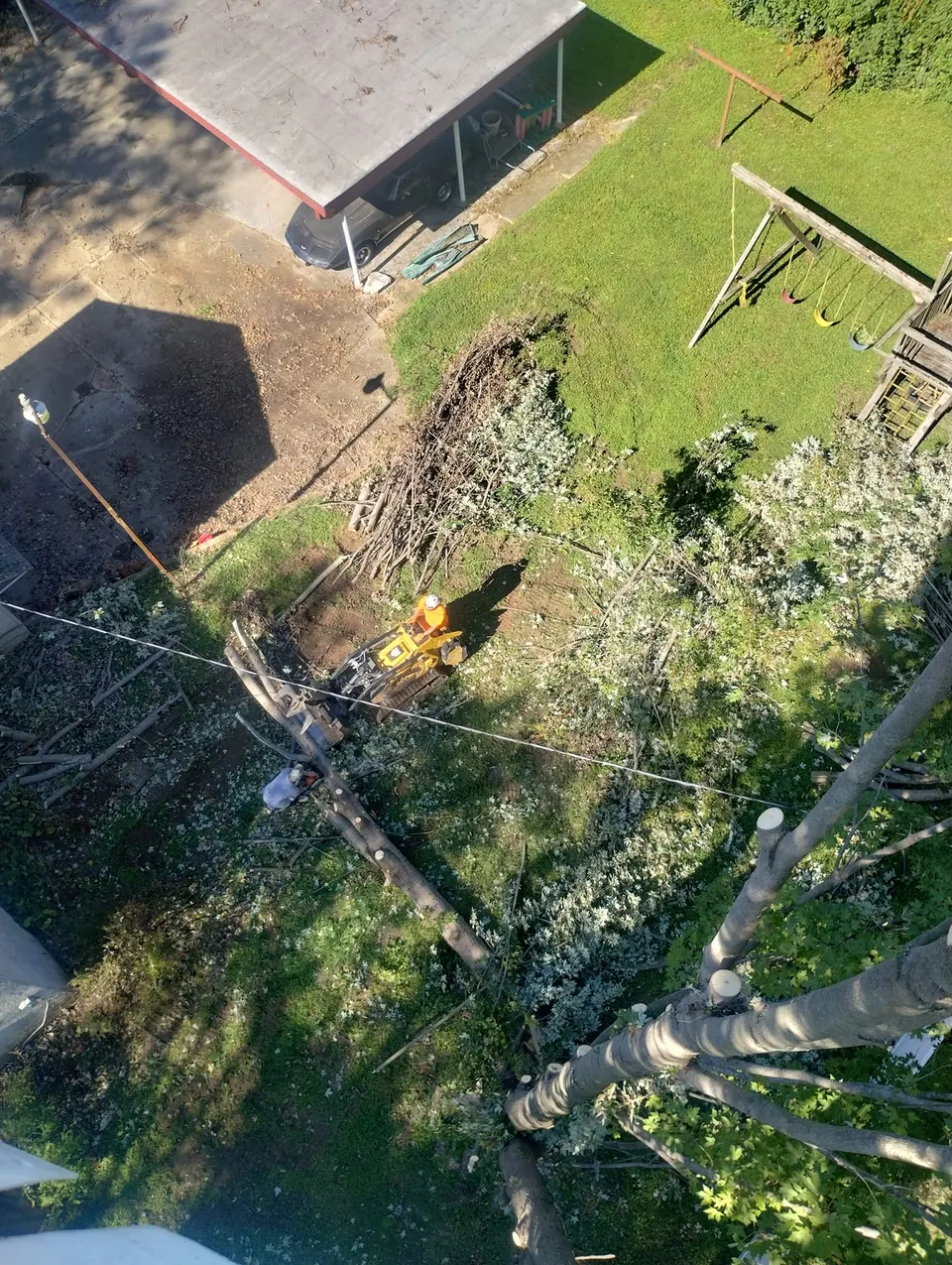
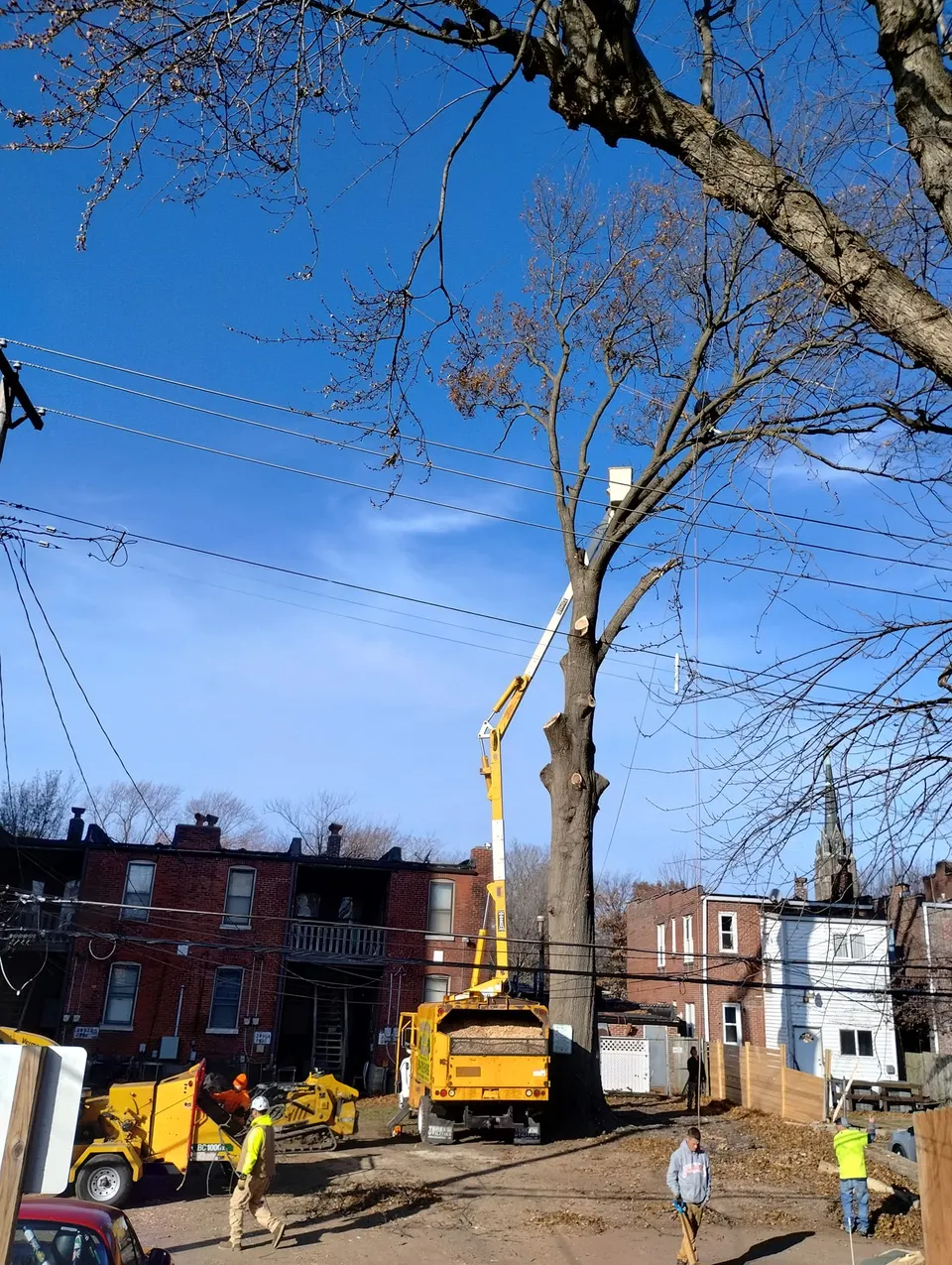
Speed matters because dead trees only get more dangerous, and more expensive, with time. A tree that could be climbed and dismantled this year may require a crane next year. Thompson Tree Care and Landscaping handles dangerous tree removal near structures and lines, as well as routine tree removal across the St. Louis area, including Kirkwood, Chesterfield, Florissant, O'Fallon, and Belleville, IL. Every removal starts with a free on-site estimate, and we offer 24/7 emergency service when a tree has already started to fail.
What Does Dead Tree Removal Cost in St. Louis?
Dead tree removal in the St. Louis area typically runs $300 to $2,500, in line with the ranges in our tree removal cost guide. Small trees under 30 feet fall at the low end; large mature oaks and sycamores at the high end. Two things push a dead tree toward the top of the range. First, brittle wood cannot be climbed safely, so crews rely on bucket trucks, cranes, or extra rigging. Second, dead trees near houses or power lines have to come down in smaller, more controlled pieces. Stump grinding is usually a separate line item. The only way to know your number is an on-site quote, which is why we provide free estimates and senior and veteran discounts.
Frequently Asked Questions
Use the scratch test. Scrape a small patch of bark off a twig with your thumbnail or a pocketknife: green, moist tissue underneath means the branch is alive; brown, dry tissue means that branch is dead. Repeat on several branches around the crown. Then snap a twig — live twigs bend, dead twigs snap cleanly. In spring, a dormant tree will also show swelling buds while a dead tree will not.
Yes. Trees move water and nutrients through the outer layers just beneath the bark, so a tree can be hollow in the center and still leaf out normally. The concern is strength, not life. A hollow trunk has lost much of the wood that resists wind and weight, so once the cavity takes up a large share of the trunk diameter, the tree becomes a structural risk even if it looks healthy from the street.
Often, yes. Mushrooms or shelf-like conks growing on the trunk or at the base are the fruiting bodies of fungi that feed on wood. When they appear at the root flare, they usually signal root or butt rot that is weakening the tree from the ground up. A single mushroom in the lawn nearby is not a concern, but fungus attached to the tree itself should be evaluated by an arborist.
Dead tree removal in the St. Louis area typically runs $300 to $2,500 depending on height, trunk diameter, and access, and brittle dead trees can cost more than a healthy tree of the same size because crews cannot safely climb them and must rely on bucket trucks, cranes, or extra rigging. Thompson Tree Care and Landscaping provides free estimates so you know the price before any work begins.