Most St. Louis homes were built with a tree or two planted "for shade" a few feet off the foundation, and fifty years later that maple or oak is a giant with limbs over the roof and roots under the basement. Whether that is a problem depends on more than distance. Thompson Tree Care and Landscaping has been assessing, pruning, and removing trees against houses across St. Louis, Kirkwood, Chesterfield, Florissant, O'Fallon, and Belleville since 2014, and this guide walks through how close is too close, what roots really do to foundations and sewer laterals, when pruning solves it, and when the tree should come out.
How close is too close for a tree to a house?
The right distance is set by the tree's mature size, not the size it was when someone planted it. Nursery tags list a mature height and spread; a good rule is to keep the trunk at least half the mature canopy spread away from the wall so the crown can develop without pressing on the house.
| Tree size at maturity | Examples common in St. Louis | Minimum distance from foundation |
|---|---|---|
| Small (under 30 ft) | Redbud, serviceberry, dogwood, crabapple, Japanese maple | 8–10 ft |
| Medium (30–60 ft) | River birch, honeylocust, red maple, Bradford pear, ornamental cherry | 15–20 ft |
| Large (60 ft and up) | Pin oak, white oak, silver maple, sycamore, sweetgum, cottonwood, tulip poplar | 20–30 ft or more |
Those numbers are for planting decisions. For a tree that already exists, distance is only the starting point. A healthy redbud four feet from the house is harmless; a 70-foot silver maple with a hollow base 25 feet away is not. The questions an arborist actually asks are: What species is it, and how aggressively does it root? Is it structurally sound? Does it lean toward the house? What is under the canopy, and what is under the ground?
What do tree roots actually do to a foundation?
Less than most homeowners fear, and more than they expect, just not in the way they picture. Tree roots do not act like a jack prying the wall apart. Roots grow along the path of least resistance, and a sound poured or block foundation is not it. When roots press against a wall they usually flatten and redirect. Cracks that look like root damage are almost always something else.
The real mechanism in St. Louis is soil moisture. Much of the metro sits on heavy, expansive clay that swells when wet and shrinks when dry. A large tree pulls hundreds of gallons of water out of that clay every summer day, drying the soil on one side of the house more than the other. The soil shrinks, the footing on that side settles a fraction of an inch, and a stair-step crack opens in the brick or a basement wall bows. The tree did the damage without a root ever touching the foundation. This is most common with big, thirsty species planted close to the house and is worse in drought years.
The second real mechanism is underground plumbing. Older homes across St. Louis City and County drain through clay sewer laterals and, in some neighborhoods, drain tile around the footing. Those pipes have joints, and over decades the joints open. Roots follow the water vapor to the joint, slip in through a hairline gap, and grow into a dense mat inside the pipe. The homeowner learns about it when the basement floor drain backs up for the third time. Roots did not "break" the pipe; the pipe was already leaking, and the roots found it.
Some species are far worse than others. Silver maple, willow, cottonwood, and poplar are the aggressive rooters of this region: fast-growing, shallow, and relentless around moisture. Sweetgum and sycamore are not far behind. Oaks, redbuds, and most ornamentals are comparatively well-behaved. If the tree near your foundation or over your sewer line is one of the first four, the calculus changes.
What are the risks above ground?
People worry about roots and forget the part of the tree that actually lands on the house. Limbs over the roof cause the everyday problems:
- Gutters and downspouts fill with leaves, seeds, and twigs several times a season, back up, and send water down the foundation, which feeds the moisture problem described above.
- Shingle abrasion: branches that touch the roof scrub the granules off asphalt shingles every time the wind blows, shortening roof life on that slope.
- Animal access: limbs within jumping distance of the roofline are a highway for squirrels, raccoons, and roof rats looking for an attic.
- Shade and moisture keep the roof damp, encouraging moss and algae and slowing drying after rain.
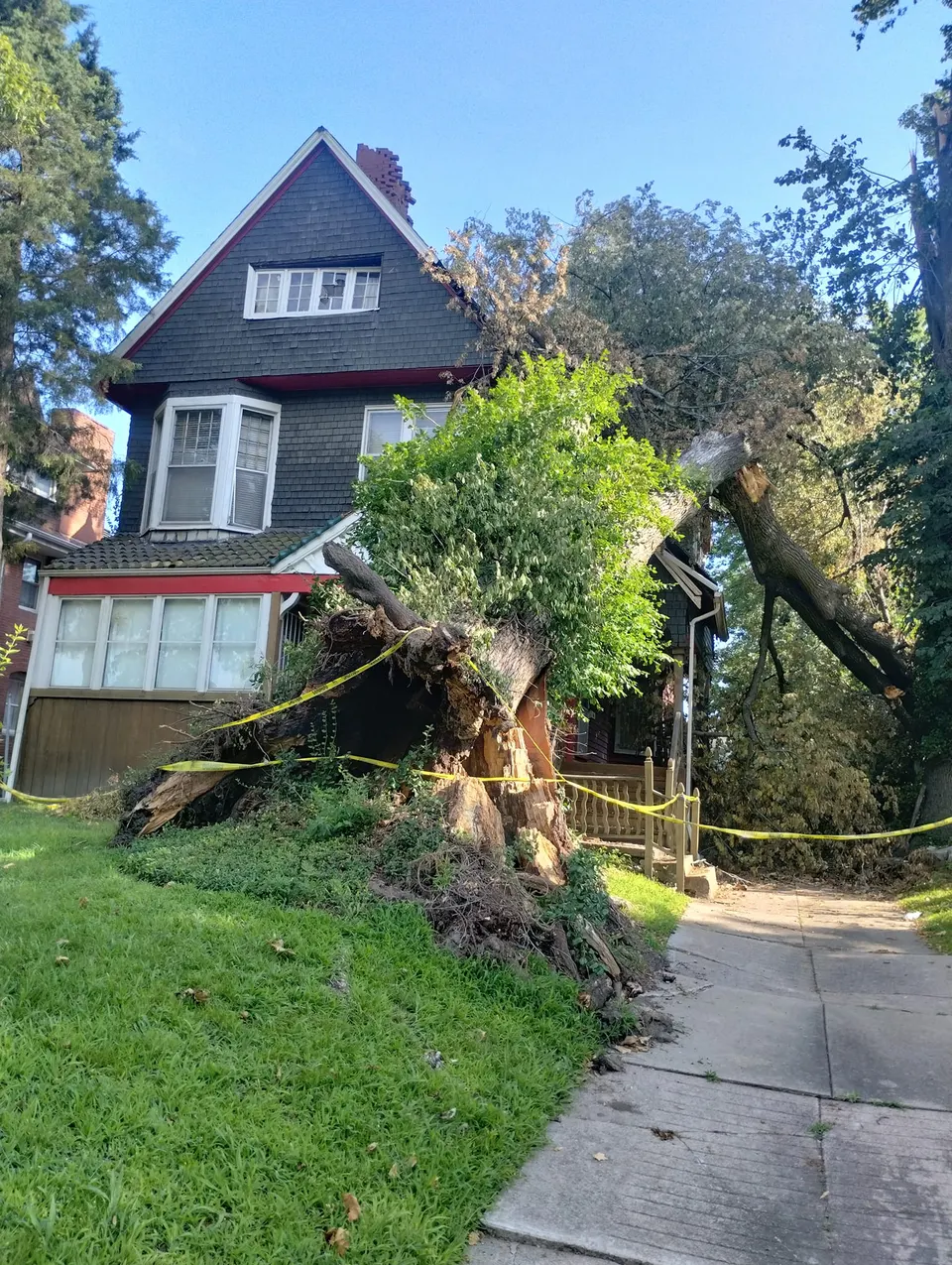
- Storm failure is the big one. A limb that hangs over the bedroom is a limb that can come through the ceiling in a July thunderstorm or February ice. Our guide to storm damage tree removal covers what to do when it happens, and whether insurance covers tree removal in Missouri explains why a tree that was known to be hazardous can complicate the claim.
When is pruning enough?
For most healthy trees that are simply too big for their spot, pruning is the answer, and it costs a fraction of removal. The goal is clearance, not amputation:
- Roof clearance pruning removes or shortens limbs so the nearest foliage sits 6–10 feet above the roof surface and clear of the gutters. Done properly with cuts at branch unions, the tree keeps its shape and heals cleanly.
- Crown reduction shortens the overall height and spread of a tree that has outgrown its space, reducing wind load and the leverage on limbs over the house. This is different from topping, which cuts limbs back to stubs and creates weak, fast-growing sprouts that fail later.
- Deadwooding and thinning take out the limbs most likely to drop and let wind pass through the canopy instead of pushing on it.
- Timing: the dormant season (roughly November through February) is best for most species, and it is mandatory for oaks, which should never be pruned April through July because of oak wilt.
Expect clearance pruning on a mature tree to fall in the same range as other trimming work; our St. Louis tree trimming cost guide breaks down what drives the price. Thompson Tree Care's tree trimming and pruning crews do this work year-round with the oak calendar in mind.
One thing pruning cannot safely fix is the root side. Root pruning near a foundation is risky. Cutting major roots within a few feet of the trunk to protect a foundation or a sewer line removes the very roots that anchor the tree, and a large tree with its buttress roots severed on the house side is more likely to fall toward the house, not less. Trenching for a root barrier or a sewer repair should always be evaluated by an arborist first; sometimes the honest answer is that the tree will not survive the dig, and it is better to remove it deliberately than to have it fail on its own a year later.
When should the tree come out?
Removal is the right call when the tree itself is the hazard, not just its location. Any of these near a house tips the decision toward removal:
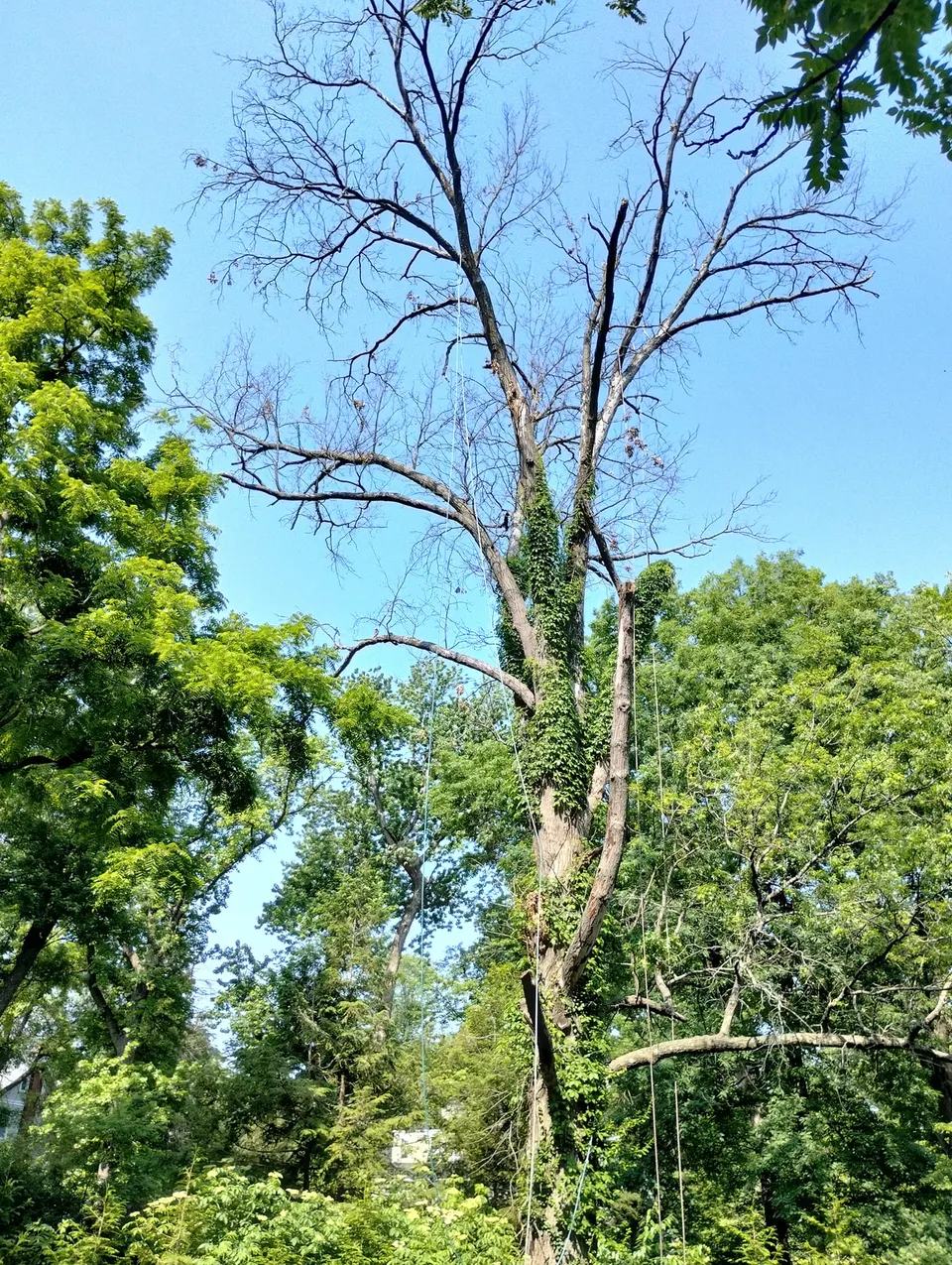
- The tree is dead or declining: thinning crown, dead limbs, bark falling off, mushrooms at the base. Our guide to the signs a tree is dead or dying walks through the checks you can do yourself.
- Cracks, cavities, or decay at the base or in the trunk, especially on the side facing the house.
- A lean toward the house that is new, worsening, or paired with cracked or heaving soil on the opposite side.
- An aggressive species within about 10 feet of the foundation: silver maple, willow, cottonwood, poplar, or a large sweetgum or sycamore that is still growing.
- Repeated sewer backups traced to roots from the same tree, where the lateral has already been cleared more than once.
- Structural defects that pruning cannot correct: co-dominant trunks with a seam of included bark, a limb the size of a tree by itself hanging over the roof, or a canopy so lopsided toward the house that reduction would leave nothing.
A tree in this condition next to a house is exactly what our dangerous tree removal service exists for. A healthy tree that is merely inconvenient is a standard tree removal, and the difference matters for how the job is planned and priced.
What does removing a tree next to a house cost, and how is it done safely?
Typical St. Louis-area tree removal runs $300–$2,500 or more, and trees against a house sit toward the high end of that range for a simple reason: nothing can be felled. Every limb has to come down under control.
Here is how a removal against a house actually goes:
- Site protection. Plywood or mats over the lawn and driveway where equipment will sit, and a plan for where each piece will land. Roof, gutters, fences, air-conditioning units, and landscaping are identified and protected before anyone climbs.
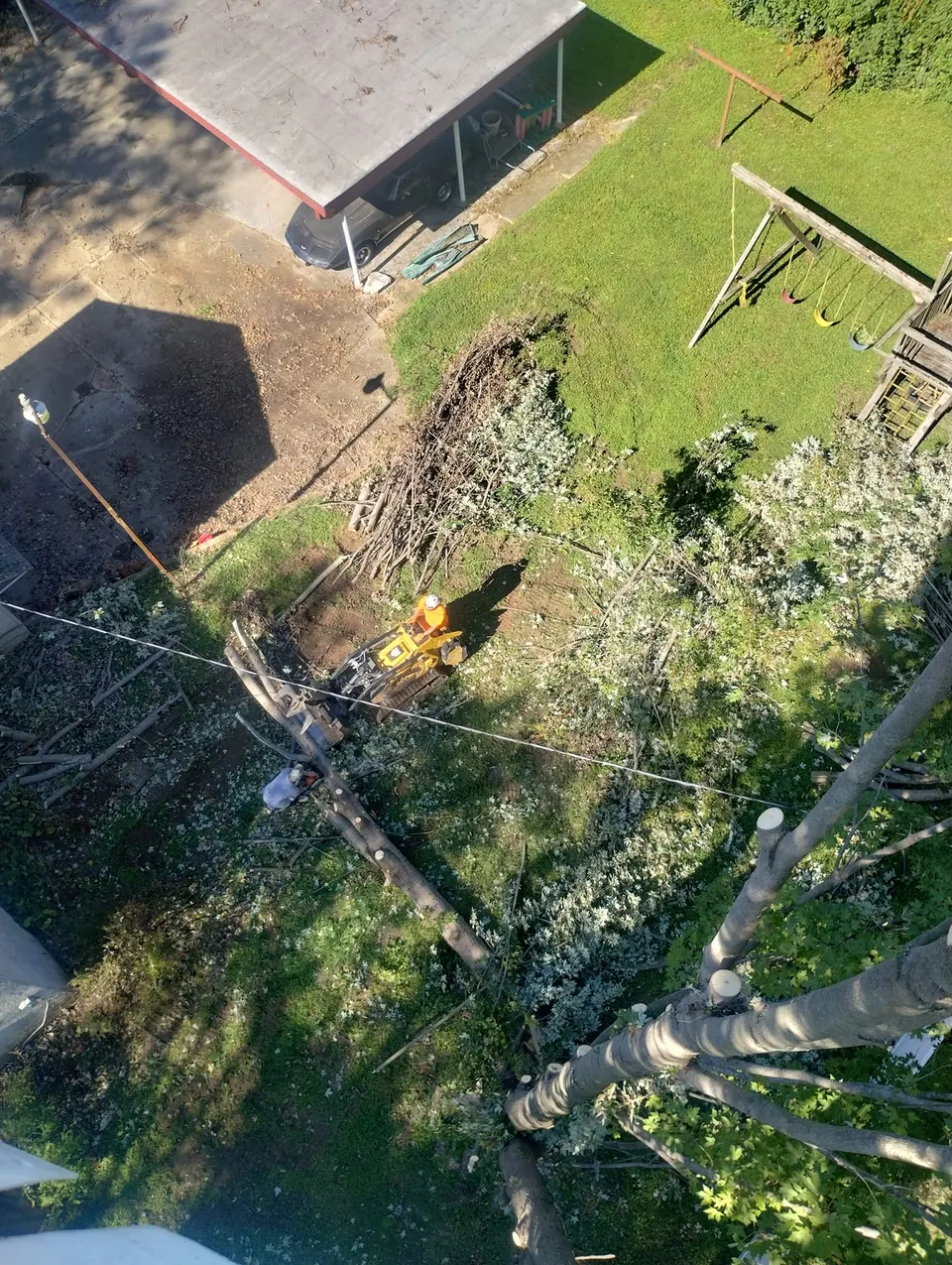
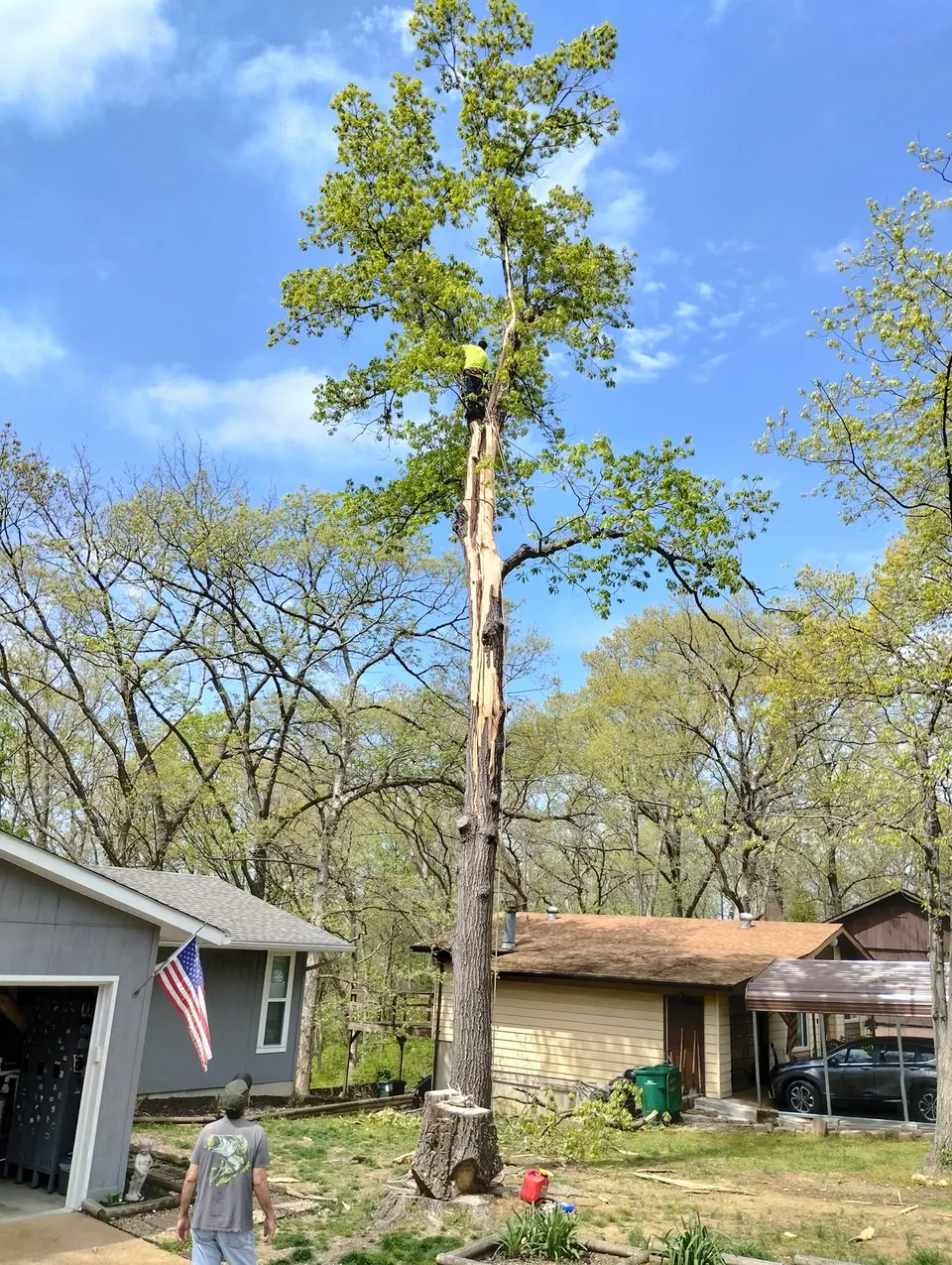
- Piece-by-piece dismantling. A climber or a bucket truck operator works from the outside of the canopy inward and from the top down. Limbs over the house are tied off, cut, and lowered on ropes by a ground crew rather than dropped. Larger sections may be lowered on a rigging system or, for very large trees in tight yards, lifted straight up and out with a crane. This is the core of our large tree removal work.
- Trunk sections. Once the canopy is down, the trunk is cut into manageable rounds and lowered or dropped into a cleared zone away from the house.
- Stump grinding and cleanup. The stump is ground below grade if requested, brush is chipped, wood is hauled or left cut to length, and the yard is raked. A tree removed for root reasons should always have its stump ground, since a living stump keeps sending out roots.
Access is the biggest price variable. A tree the crew can reach with a bucket truck from the driveway is a very different job from the same tree in a fenced backyard where every piece has to be carried out by hand or lifted over the house by crane. Thompson Tree Care and Landscaping is licensed and insured, has completed more than 500 jobs across the St. Louis metro since 2014, and holds a 4.8-star Google rating from 60+ reviews. Estimates are free, and we offer senior and veteran discounts.
What should you plant instead, and where?
Taking out the wrong tree is a chance to put in the right one. Use the distance table above and think about what the tree will be in forty years, not what it looks like in a five-gallon pot. Near the house, favor small trees with well-behaved roots: eastern redbud, serviceberry, flowering dogwood, American hornbeam, or a Japanese maple. Save the big shade trees, white oak, bur oak, blackgum, Kentucky coffeetree, for the part of the yard where their canopy will clear the roof and their roots will stay out of the sewer line. Mulch the new tree, water it deeply through its first two summers, and it will do everything the old one did without the problems.
If you are not sure which side of the line a tree near your house falls on, that is what the free estimate is for. Call (314) 712-3035 or request an assessment online, and a member of the Thompson Tree Care team will look at the tree, the roof, and the ground around it and give you a straight answer about pruning versus removal. Our certified arborist assessment is the right starting point when the tree is large, old, or close enough to matter.
Frequently Asked Questions
As a rule of thumb, small ornamental trees should be at least 10 feet from the foundation, medium trees 15 to 20 feet, and large shade trees 20 feet or more. A tree that is closer is not automatically a problem; species, health, lean, and what sits beneath the canopy matter more than the tape measure. A certified arborist assessment is the way to know for sure.
Roots rarely crack a sound concrete foundation on their own. The more common problem in St. Louis is indirect: roots pull moisture out of heavy clay soil, the soil shrinks and swells, and footings shift. Roots also grow into cracked drain tiles and old clay sewer laterals, which is why repeated sewer backups are often the first sign of a root problem.
A tree that has always grown at a slight angle toward the light is usually stable. A lean that is new, that is getting worse, or that comes with cracked soil, heaving roots, or a crack at the base is a hazard and should be looked at right away. Thompson Tree Care provides free on-site estimates and 24/7 emergency service for trees that are actively failing.
Typical St. Louis-area tree removal runs $300 to $2,500 or more. Trees within a few feet of a house sit toward the high end because they have to be dismantled piece by piece with ropes, a bucket truck, or a crane rather than felled in one cut. The exact price depends on height, canopy spread, access for equipment, and whether the stump is ground. Estimates are free.