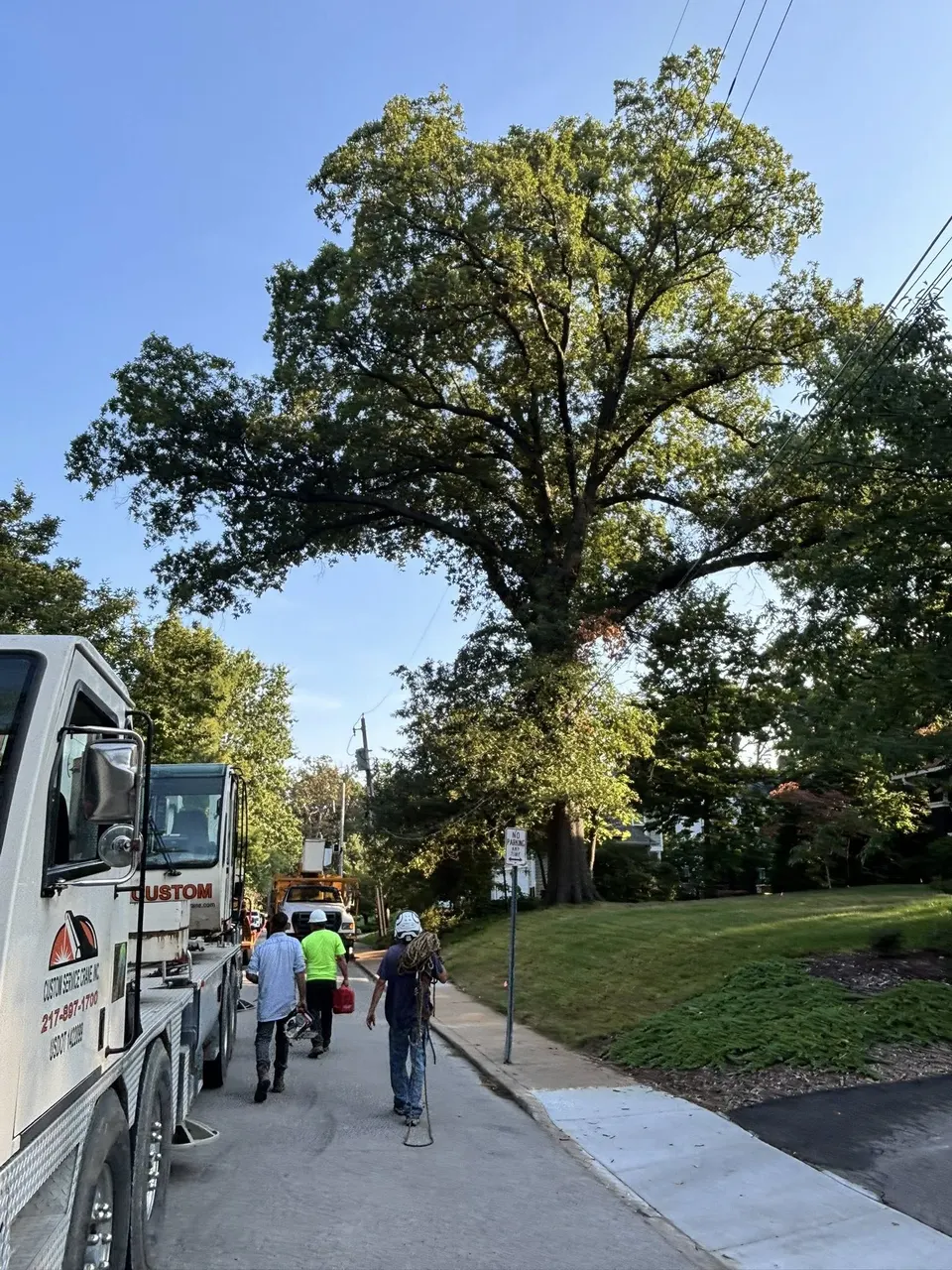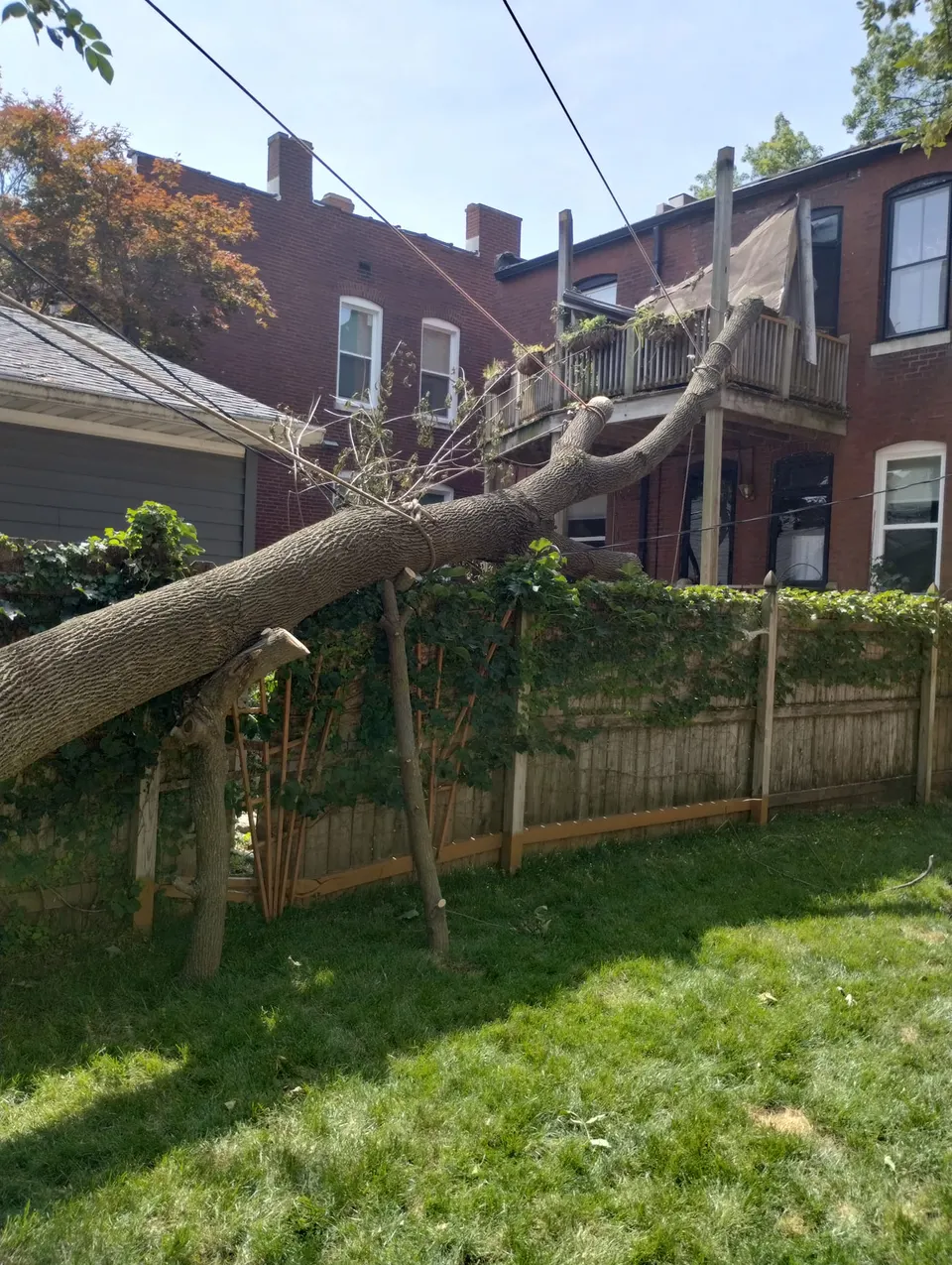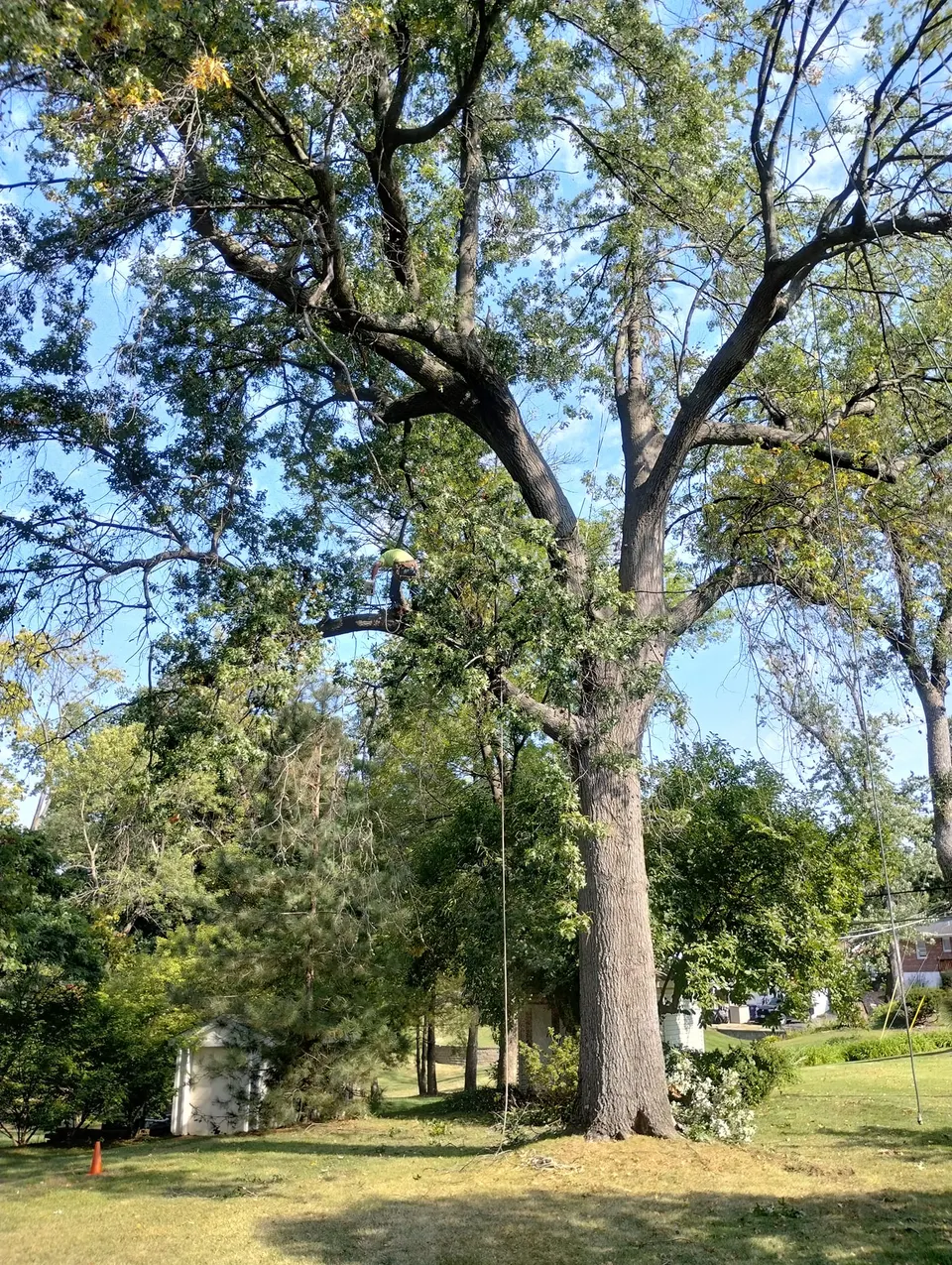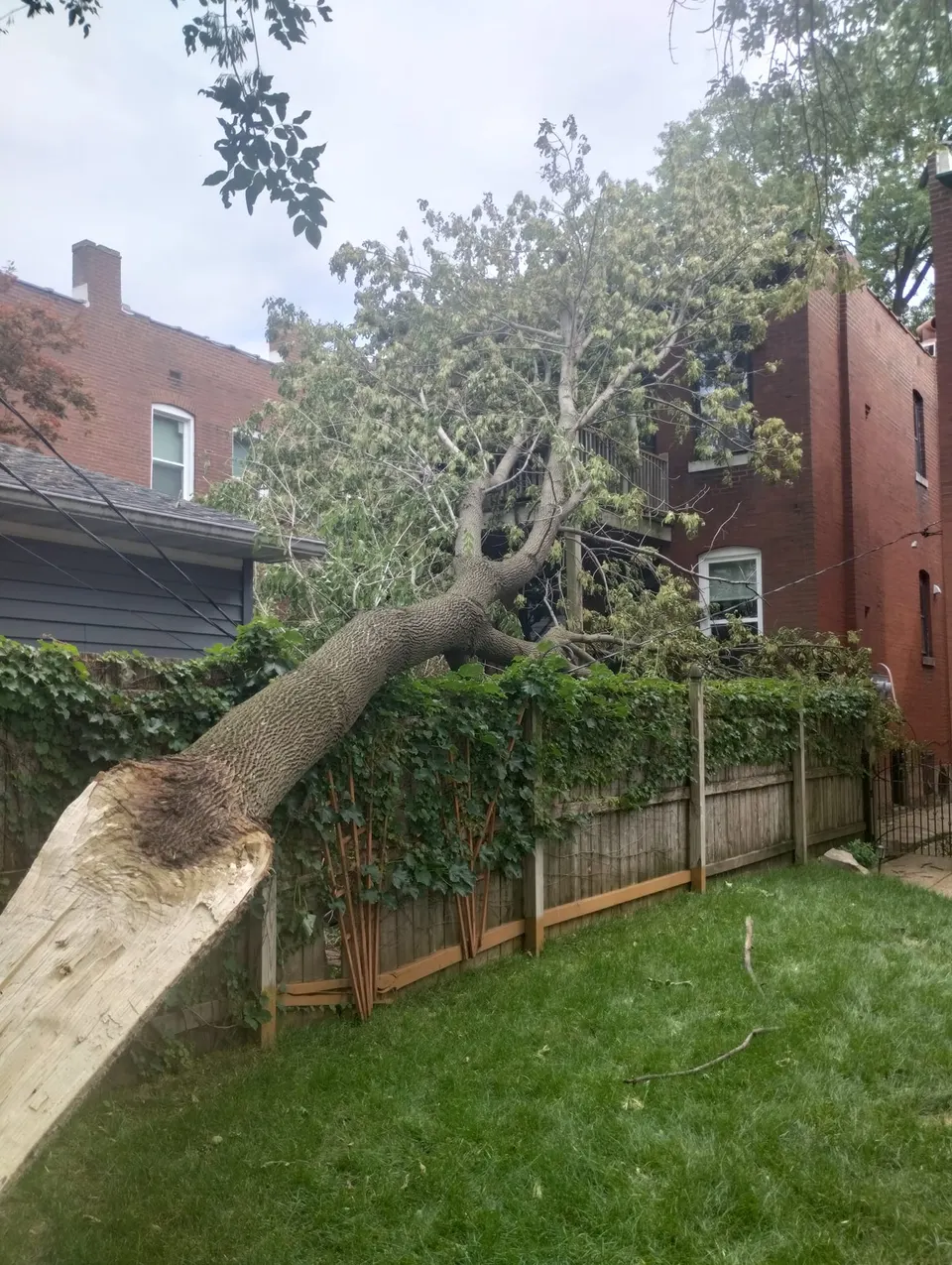
Almost every St. Louis yard has at least one tree that does not stand perfectly straight, and most of them will outlive the house. The problem is that the dangerous kind of lean and the harmless kind can look alike from the kitchen window. One is a tree that has spent forty years reaching around a neighbor's roof for sunlight. The other is a tree whose root plate let go last night and is now being held up by habit. Thompson Tree Care and Landscaping has been assessing and removing leaning trees across the metro since 2014, and this guide walks through how to tell the two apart, what a sudden lean after a storm means, whether a leaning tree can be fixed, and when it simply has to come down.
Why do trees lean in the first place?
Most leans are not defects. Trees are opportunists, and a lean is often just the shape a tree took to get what it needed.
- Reaching for light. A tree hemmed in by a house, a garage, or bigger trees grows toward the open sky. The trunk angles away from the shade and the crown ends up lopsided on the sunny side. This is phototropism, and it is the single most common reason a yard tree leans.
- Growing on a slope. Trees on hillsides and creek banks, common in the older parts of Kirkwood, Webster Groves, and along the River des Peres, often start life leaning downhill and then correct themselves as they grow.
- Shaped by wind. Trees on exposed lots or the edge of a field lean away from the prevailing wind. In St. Louis that usually means a slight lean to the northeast.
- Corrected with reaction wood. A healthy tree that leans builds extra-dense wood on one side of the trunk to hold itself up. In hardwoods it forms on the upper side of the lean, and it is why so many leaning trees have a trunk that curves back toward vertical as it rises. That curve is a sign the tree has been managing its lean for a long time.
- Leaning since planting. Some trees were simply planted crooked or were staked badly and never straightened. They stabilize with age, though they may keep a permanent tilt.
The common thread is time. A tree that grew into its lean gradually has had years to anchor itself. The lean you need to worry about is the one the tree did not plan for.
How can you tell a natural lean from a dangerous one?
Walk around the tree and look at the ground, the trunk, and the direction of the lean. These are the same things an arborist checks first.
Signs the lean is probably fine
- The tree has leaned the same amount for as long as anyone remembers.
- The trunk curves back toward vertical above the lean, and the crown is balanced overall.
- The soil around the base is flat, undisturbed, and covered with the same grass or mulch as the rest of the yard.
- No roots are visible above ground on the side away from the lean.
- The bark on both sides of the trunk is intact, with no cracks, seams, or swelling.
Signs the lean is a problem
- It is new or getting worse. A tree that was straight last year and is leaning this year is moving, and trees that move do not stop on their own.
- The soil is mounded or cracked on the side opposite the lean. This is the root plate lifting out of the ground. It is the clearest sign of root failure and it means the tree is being held by less than it looks.
- Roots are exposed or snapped on the high side, or you can see a gap between the soil and the root flare.
- The trunk shows a crack, a seam, or a bulge on the underside of the lean, where the wood is in compression. A bulge or ripple in the bark there means fibers are buckling.
- The angle is steep. Many arborists treat a lean of more than roughly 15 degrees from vertical as a tree that needs a proper assessment, regardless of how long it has been that way. Any new lean, at any angle, is urgent.
- The base shows decay. Mushrooms or shelf fungus at the root flare, soft or hollow-sounding wood, or a cavity mean the anchor itself is compromised. Our guide to what mushrooms growing on a tree mean covers how to read those signs.
Then ask the question that actually decides urgency: what is it leaning toward? A tree leaning into an open field is a problem for the tree. A tree leaning toward the house, the driveway where the kids park, the sidewalk, or a power line is a problem for you, and it moves to the top of the list.
What does a sudden lean after a storm mean?
A tree that was vertical on Tuesday and leaning on Wednesday has almost always suffered root plate failure. Wind loads the crown like a sail, the trunk acts as a lever, and the roots on the windward side either tear or pull through the soil. Once that happens the tree is standing on the roots that are left, and every gust works on them a little more.
St. Louis weather produces this failure in two ways. Summer thunderstorms and the occasional derecho bring straight-line winds that hit when the crown is in full leaf and the soil is often saturated from the same storm, which is the worst possible combination: maximum sail, minimum grip. Winter ice storms add hundreds of pounds to the crown and can lever a tree over even in light wind. Trees on lots that were recently graded, trenched for utilities, or had a driveway poured over the roots are the most likely to go, because their anchoring roots were already cut.
Treat a new lean over a house, driveway, sidewalk, or power line as an emergency:
- Keep people, pets, and cars out from under the crown and the fall zone beyond it. A leaning tree can fall farther than it looks.
- Do not try to prop it, rope it, or cut anything off it. Removing weight from one side can shift the balance and bring the whole tree down.
- If it is leaning toward a power line, or has already contacted one, stay well clear and call Ameren before anyone else.
- Photograph the tree, the soil, and anything it has damaged before it is touched. Our guide to insurance and tree removal in Missouri explains what a claim will need.
- Call for 24/7 emergency tree service. A partially uprooted tree is a same-day job, not a next-week one.
For the broader checklist after severe weather, see what to do after storm damage to your trees.
Can a leaning tree be fixed or straightened?
It depends almost entirely on size and age.
Young trees, yes. A tree planted in the last two or three years, with a trunk you can wrap a hand around, can usually be pulled upright and staked. Loosen the soil on the high side, ease the tree vertical, and stake it with wide, flexible straps that allow some movement so the trunk keeps building strength. Remove the stakes after a year. Water it through the next summer while the roots re-establish.
Mature trees, no. A large tree cannot be winched straight. The roots that are still holding it are the reason it has not fallen, and pulling the trunk back to vertical tears them. Even if the tree stands afterward, it stands on less than it did before. For a mature tree with a lean that is stable but concerning, the realistic options are:
- Crown reduction. Reducing the height and spread of the crown, especially on the leaning side, cuts the sail area that wind pushes against and shifts the tree's weight back over its roots. This is skilled pruning work, not topping, and on oaks it has to wait for the dormant season.
- Cabling and bracing. When the lean is really a split between two co-dominant stems, or a heavy limb pulling the tree off balance, cabling and bracing can support the weak union and keep a valuable tree in place. Cables support the crown; they do not fix a failing root system.
- Removal. When the roots are the problem, nothing above ground fixes it.
An honest assessment tells you which of the three you are looking at. Our certified arborist assessment is free, and we would rather tell you a tree is fine than sell you work it does not need.
When does a leaning tree have to come down?
Some leaning trees are not candidates for pruning or cables, and the sooner that is recognized the cheaper and safer the removal is. The tree should come out when:
- The lean is recent and there is any sign of root movement, even if the tree seems to have settled. A tree that has moved once will move again in the next storm.
- The soil has heaved or roots are exposed on the high side. The anchor is gone.
- The base is decayed or hollow. A hollow trunk can carry a vertical tree for decades, but a lean puts the hollow side in compression. Our guide to whether a hollow tree is dangerous explains how much sound wood a trunk needs.
- The trunk is cracked or bulging on the compression side.
- The tree is also dead or declining. A leaning tree that is losing its crown has two strikes; see the signs a tree is dead or dying.
- There is a target under the lean and any of the above applies. A house, a bedroom, a driveway, a sidewalk, a play area, or a neighbor's property turns a maybe into a yes.
Leaning trees over structures are dangerous tree removal work by definition. The crew has to take the tree down against its lean, piece by piece, with every section rigged so it cannot swing into the house it is leaning toward. That is not a job for a homeowner with a chainsaw, and it is not a job for a landscaper with a ladder. Straightforward cases are handled by our regular tree removal crew; anything under load or over a target goes to the hazard crew.
What does it cost to remove a leaning tree?
Typical St. Louis-area tree removal runs $300-$2,500 or more, with size, access, and hazards driving the price. Leaning trees tend toward the upper end of the range for a tree of a given size, for one reason: the wood is under tension. A trunk that is leaning is loaded like a spring, and a partially uprooted tree can roll, kick, or drop unexpectedly when the wrong cut is made. Crews slow down, rig more, and often work from a bucket truck or bring in a crane to lift sections straight up rather than let them swing. Emergency after-hours response adds to the cost as well.
Waiting rarely saves money. A tree that has started to fail becomes more dangerous, not less, and a tree that finishes falling on its own on a Saturday night costs more to deal with than one removed on a scheduled weekday, before it lands on the roof.
Thompson Tree Care and Landscaping is licensed and insured, has completed more than 500 jobs across St. Louis, Kirkwood, Chesterfield, Florissant, O'Fallon, and Belleville since 2014, and holds a 4.8-star Google rating from 60+ reviews. Estimates are free, we offer senior and veteran discounts, and we answer the phone around the clock for storm emergencies. If a tree on your property is leaning and you are not sure which kind of lean it is, call (314) 712-3035 or request an estimate online and we will come look before the next storm does.
Frequently Asked Questions
A tree that has leaned the same way for years, with a trunk that curves back toward vertical and firm, undisturbed soil around the base, is usually stable. A tree that has started leaning recently, especially after a storm, or that shows cracked or mounded soil, exposed roots, or a bulge on the trunk is failing at the roots and should be treated as a hazard until an arborist has looked at it.
A small tree planted within the last two or three years can often be pulled upright and staked while its roots re-establish. A mature tree cannot. Winching a large tree back to vertical tears the roots that are still holding it and makes failure more likely. For mature trees the realistic options are crown reduction to cut wind load, cabling for split or co-dominant stems, or removal.
Keep people, cars, and pets out from under it, and do not try to prop or cut it yourself. Check the ground on the side opposite the lean for cracks, lifted turf, or exposed roots. If the tree is over a house, driveway, sidewalk, or power line, call for emergency tree service the same day. If it is leaning toward a power line, call Ameren first and stay well clear.
Typical St. Louis-area tree removal runs $300-$2,500 or more depending on size, access, and hazards. A leaning or partly uprooted tree usually costs more than a healthy tree of the same size because the trunk and limbs are under tension and have to be rigged or lifted rather than climbed. After-hours emergency response adds to the price. Thompson Tree Care estimates are free.