An ice storm can leave a St. Louis yard looking beautiful and dangerous at the same time. Ice adds heavy weight to every twig, and trees with brittle wood or weak branch unions can fail all at once. What you do in the first hour and the next few days decides whether you only lose a few limbs or end up with a bigger repair. This guide covers what to do during and right after the storm, how to judge what can be saved, and when to call a pro.
Should you knock the ice off a tree?
No. Shaking or hitting a tree to knock ice off is one of the most common mistakes people make. Ice-coated wood is brittle and already under stress, so a hit or a shake can snap a limb that would have held. The branch, and the ice with it, comes down on whoever is under it.
Let it melt. Ice-loaded branches that are bent but not broken often spring back as the weight goes, particularly on younger, flexible trees. Stay off ladders, do not climb, and do not try to prop or tie up heavy limbs by hand. If a branch is bowed over a driveway or walkway, keep people and cars out of that area until the ice is gone.
What is dangerous after an ice storm?
Three things hurt people most:
- Loaded limbs. A limb can release without warning, including hours after the storm when temperatures rise and ice begins to slide. Do not park, walk, or let children play under overloaded branches.
- Hanging and partly broken limbs. A limb snapped but still caught in the crown is under tension and can fall when it is disturbed. Arborists call these hangers.
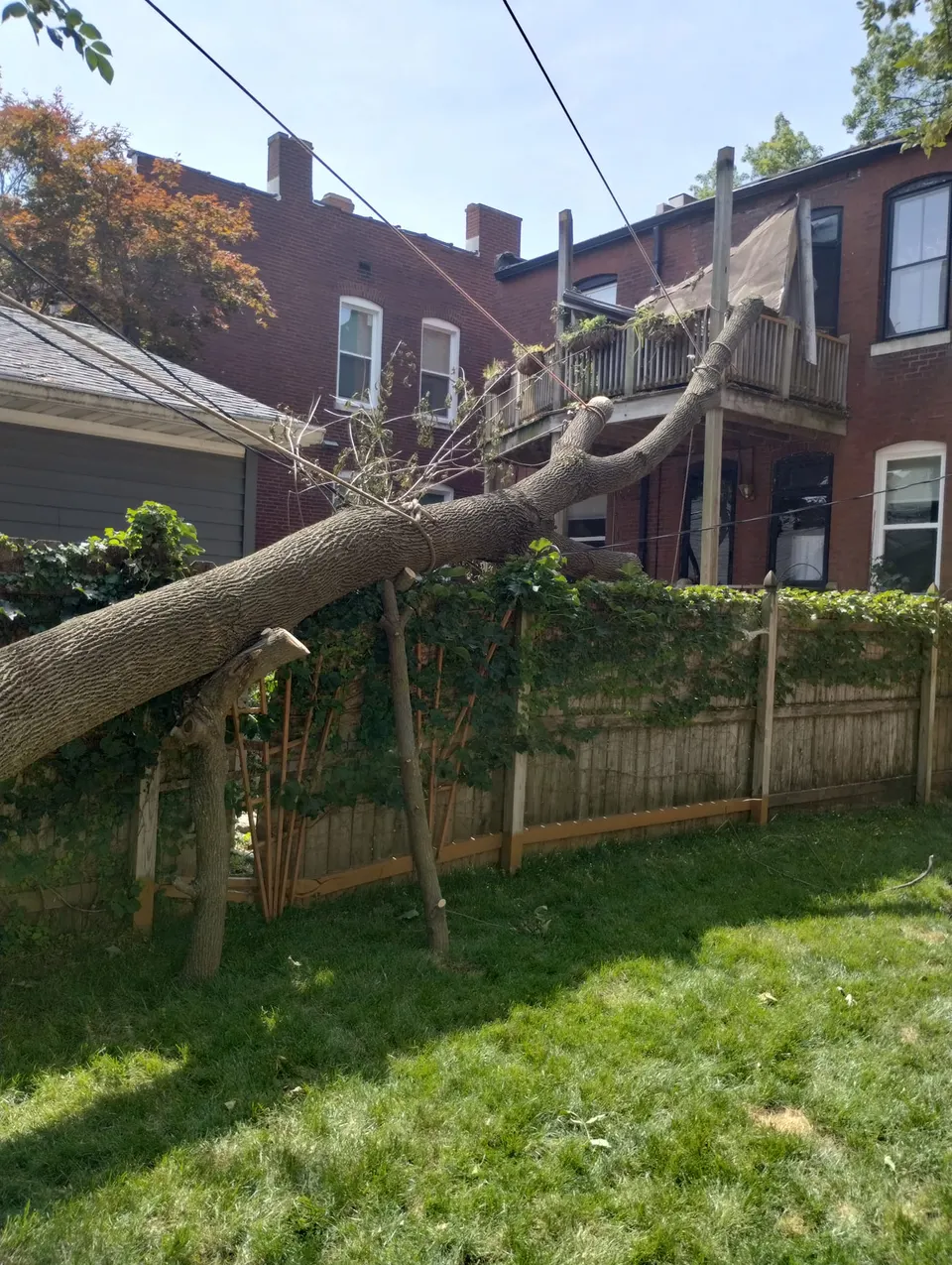
- Downed or tangled power lines. Treat every wire as live, including one lying on or under a branch. Trees conduct electricity. Stay far back, keep others away, and call your electric utility. If a line is on a person, a car, or a house, call 911.
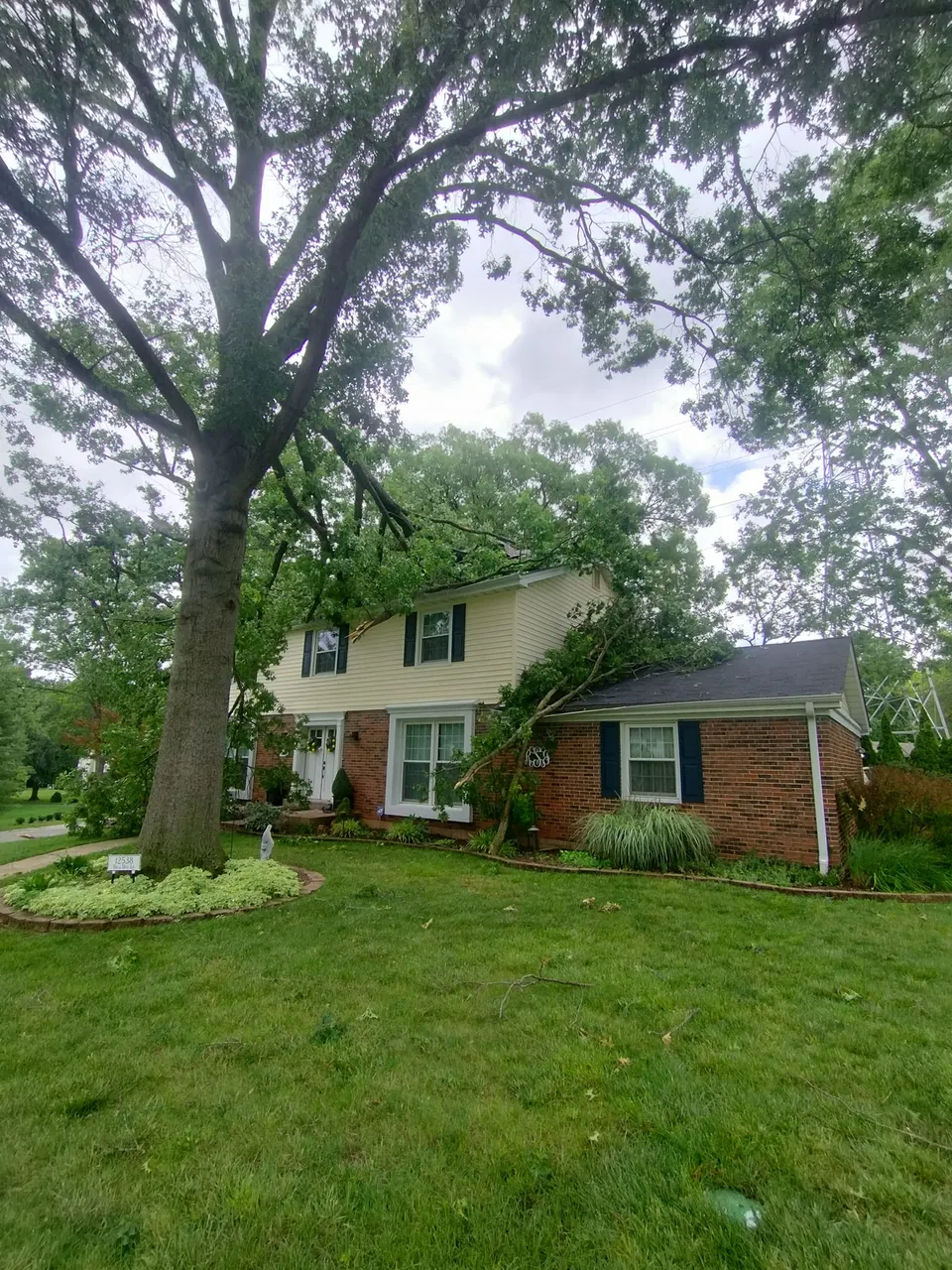
If a tree or limb has fallen on your house, leave the area it threatens and call for help before going back inside. Our guide on what to do after storm damage walks through the full first-hour checklist, and our emergency tree service is available around the clock when something is blocking a door, driveway, or road, or hanging over a structure.
How do you document ice damage for insurance?
Take photos and video from a safe distance before anything is moved: the whole tree, each broken limb, the point where it broke, and any damage to the roof, fence, vehicles or siding. Note the date and time. Do not step into the fall zone to get a better angle. Keep every receipt for emergency work, such as removing a limb from a house or driveway, and tell your insurer before major work starts when you can.
Coverage depends on your policy and on what the tree hit, and we cannot tell you what your insurer will pay. Our post on whether insurance covers tree removal in Missouri explains the common rules and what adjusters usually look for.
Which ice-damaged trees can be saved?
Wait for the ice to melt, then look at the tree again from the ground. A tree is usually worth keeping when:
- The trunk is intact and the main structure of the crown is still there.
- Damage is limited to small and medium limbs that have broken cleanly, with the rest of the crown healthy.
- Bent limbs have returned toward their normal position and show no cracks.
These cases usually call for pruning the broken limbs back to a proper cut at the branch collar, which lets the tree seal the wound. Tree trimming and pruning after an ice storm should be done by someone with the right equipment and training, and it should not turn into topping. See why tree topping hurts a tree before anyone offers to just cut it all back.
For a valuable tree with a sound trunk that has weak unions but has not failed, cabling and bracing can reduce the chance of a split in the next storm. It is a pre-damage option, not a repair for a limb that has already broken.
Which ice-damaged trees need to come down?
Removal is the safer answer when:
- The trunk is split or cracked, or the tree has lost a main leader or a large part of its crown.
- A multi-stem tree has split apart at the base, or a large limb has torn away from the trunk and left a deep wound.
- The tree is leaning or has lifted at the roots since the storm.
- Broken limbs are caught above a house, driveway, play area or power line and cannot be removed safely.
- The tree was already dead, hollow or decayed before the storm.
Pear and birch trees that are commonly planted in St. Louis neighborhoods are known for splitting under ice because of their branch structure, which is why our posts on Bradford pear problems and river birch problems cover this issue. When removal is the right call, our storm damage tree removal crews can clear the damage and haul it away, and a stump can be handled afterward. Typical St. Louis-area tree removal runs $300-$2,500 depending on size and access.
When should you call an arborist?
Call right away if a limb or tree is on or threatening a structure, a vehicle, a road or a line, or if you cannot tell whether a hanging limb is stable. For damage that is no longer an emergency, such as a few broken limbs in the back yard, it is fine to wait for the thaw and call for an assessment. Be cautious of anyone who knocks on your door after a storm, asks for payment up front, or wants to top the tree. Ask for proof of insurance and a written estimate.
A few weeks later, look at the tree again. Ice damage can reveal decay or weak unions that were hidden, and small broken limbs left in place can become entry points for decay.
Thompson Tree Care and Landscaping is locally owned, licensed and insured, and has served the St. Louis area since 2014. We hold a 4.8-star Google rating from 65 reviews. Estimates are free, and we offer senior and veteran discounts. If ice has bent or broken limbs on your trees, we will tell you what can be saved and what needs to come down, and handle the cleanup. We also respond to emergencies 24/7. Call (314) 712-3035 or request an estimate online.
Frequently Asked Questions
No. Ice-coated wood is brittle, and shaking or hitting a branch can snap it and drop it, along with the ice, on you. Let the ice melt on its own. Keep people and cars out from under any bowed or overloaded limb until it does.
Often yes, if the trunk is intact and damage is limited to small or medium limbs. Bent limbs frequently spring back as the ice melts, and broken limbs can be pruned back properly. Split trunks, torn unions, and a lost main leader usually mean the tree should be removed.
Stay far away from the tree and the line, keep others back, and call your electric utility. Treat every downed or tangled line as live. If anyone is hurt or a line is on a car or house, call 911. Do not try to move branches off a line yourself.
It depends on your policy and on what the tree hit. Take photos and video from a safe distance before anything is moved, keep receipts for emergency work, and contact your insurer. Our post on tree removal and insurance in Missouri explains the common rules.