Before the 1960s, American elms were the street tree of St. Louis. Their vase-shaped crowns met over the middle of the road in Kirkwood, Webster Groves, University City, and the older parts of Florissant, and a few of those giants are still standing. Every one of them is living on borrowed time, because the disease that emptied those streets never left. Thompson Tree Care and Landscaping still gets calls every summer about "an elm that's dying from the top," and most of them are Dutch elm disease. This guide explains what it is, how to recognize it early enough to matter, what can and cannot be done about it, and why a dead elm needs to come down faster than almost any other tree.
What is Dutch elm disease?
Dutch elm disease is caused by the fungus Ophiostoma novo-ulmi (an aggressive strain that largely replaced the original Ophiostoma ulmi). It got its name from the Dutch scientists who first described it in the 1920s, arrived in the United States on imported elm logs around 1930, and had spread across Missouri by the middle of the century. Once inside a tree, the fungus grows in the water-conducting vessels just under the bark. The elm tries to wall it off by plugging those vessels, and that defense is what kills the tree: water stops reaching the leaves, and the crown wilts even in wet soil.
Not every elm is equally at risk:
- Highly susceptible: American elm, slippery (red) elm, and rock elm, which are the native elms found in older St. Louis yards and along creeks.
- Tolerant: Chinese (lacebark) elm and Siberian elm, the fast-growing elms common in newer subdivisions. They can carry the fungus and the beetles that spread it, but rarely die from it.
- Resistant cultivars: selected American elms such as Princeton, Valley Forge, Jefferson, and New Harmony, which are what you should plant if you want an elm back (more on that below).
What are the symptoms of Dutch elm disease?
The classic sign is called flagging, and it shows up from roughly late May through July:
- A single branch high in the crown turns yellow while the rest of the tree looks fine.
- Within days to a couple of weeks the leaves on that branch turn brown, curl, and hang on rather than dropping, so the "flag" is visible from the street.
- Neighboring limbs follow, and the wilt works through the crown branch by branch.
- If you snap off a wilted twig and peel the bark, the sapwood shows brown or dark streaks and rings that healthy elm wood never has. That streaking is the single most useful home check.
- A tree infected by beetles can die over two to three seasons. A tree infected through its roots often dies in one, because the fungus enters low in the trunk and spreads everywhere at once.
Because a flag can look like a broken branch or a bit of storm damage, most homeowners lose the first summer to "waiting to see." With this disease, the first summer is usually the only one where anything can be done.
How does Dutch elm disease spread?
Two ways, and both explain the rules in the next sections.
Above ground, by elm bark beetles. The native elm bark beetle and the smaller European elm bark beetle breed under the bark of dead and dying elms, including cut elm logs and firewood. Adults emerging from infected wood carry fungal spores on their bodies and fly to healthy elms to feed in the crotches of young twigs, inoculating the tree through the feeding wounds. That is why a pile of elm firewood behind the garage can be the source of a whole block's infections.
Below ground, through root grafts. Elms growing within about 50 feet of each other fuse their roots together over the years. Once one tree is infected, the fungus moves straight through the shared roots into the next tree, no beetle required. This is why street elms in a row die in sequence, and why removing the dead tree without dealing with the roots often does not stop the losses.
Is it Dutch elm disease or something else?
Several problems put brown leaves on an elm in summer, and the treatment for each is different, so confirmation is worth the effort:
- Elm yellows (elm phloem necrosis) — the whole crown yellows and droops at once in late summer rather than flagging one branch; the inner bark near the base turns butterscotch-colored and smells faintly of wintergreen. Also fatal, spread by leafhoppers.
- Bacterial leaf scorch — browning starts at the leaf margins with a yellow halo, appears in late summer, and worsens a little each year rather than sweeping through in weeks.
- Drought and heat stress — leaves scorch evenly across the tree and brown fully before they drop; no streaking under the bark.
- Oak wilt — a closely related wilt fungus, but it attacks oaks, not elms. If the browning tree is an oak, read our oak wilt guide instead.
A wilted twig sample can be cultured for the fungus through the University of Missouri Extension's plant diagnostic clinic. Our certified arborist assessment includes the field checks above and sampling when the diagnosis is not obvious, and our field guide to common tree diseases and pests in St. Louis covers the look-alikes in more detail.
How is Dutch elm disease treated and prevented?
There is no product that cures a tree once the fungus is in the trunk. Everything that works is either early, preventive, or aimed at protecting the elms nearby.
Therapeutic Pruning (Early Flags Only)
If the tree shows a single flag and less than roughly 5 percent of the crown is involved, removing the affected limb well below the symptoms, at least 8 to 10 feet past the last visible streaking in the wood, sometimes stops the disease. It only works when the infection came from a beetle feeding high in the crown, not from the roots, and it has to happen within days of the flag appearing. Prune elms only in the dormant season otherwise, since fresh cuts in spring and summer attract the beetles.
Fungicide Injection
Trunk injections of propiconazole or thiabendazole, applied by a licensed pesticide applicator, can protect a healthy, high-value elm from beetle-borne infection and occasionally arrest an early infection. They must be repeated every two to three years for the life of the tree, and they do not protect against root-graft infection. Thompson Tree Care does not apply pesticides ourselves; when an elm is worth the ongoing cost, we assess and coordinate treatment with a licensed applicator.
Root-Graft Disruption
Where a diseased elm stands within about 50 feet of a healthy one, cutting the roots between them with a trencher or vibratory plow, three to four feet deep, blocks the underground route. It should be done before the diseased tree is removed, since taking the tree down first can push the fungus outward through the grafts. Call 811 for utility locating before any trenching.
Sanitation
This is the part most people skip and the part that matters most for the neighborhood. Dead and dying elms are beetle nurseries. Remove them promptly, chip the brush, and either debark the logs or get rid of them; do not stack elm firewood, and never haul elm wood to another property. Every infected elm left standing through a spring produces the next generation of spore-carrying beetles.
When does an elm with Dutch elm disease have to come out?
If the tree has lost more than a small portion of its crown, was infected through the roots, or is simply an American elm that has been flagging for more than one season, removal is the answer, and sooner is better for three reasons:
- It protects the other elms. The beetles breeding in your dying elm are the ones that will infect the survivors down the street next spring.
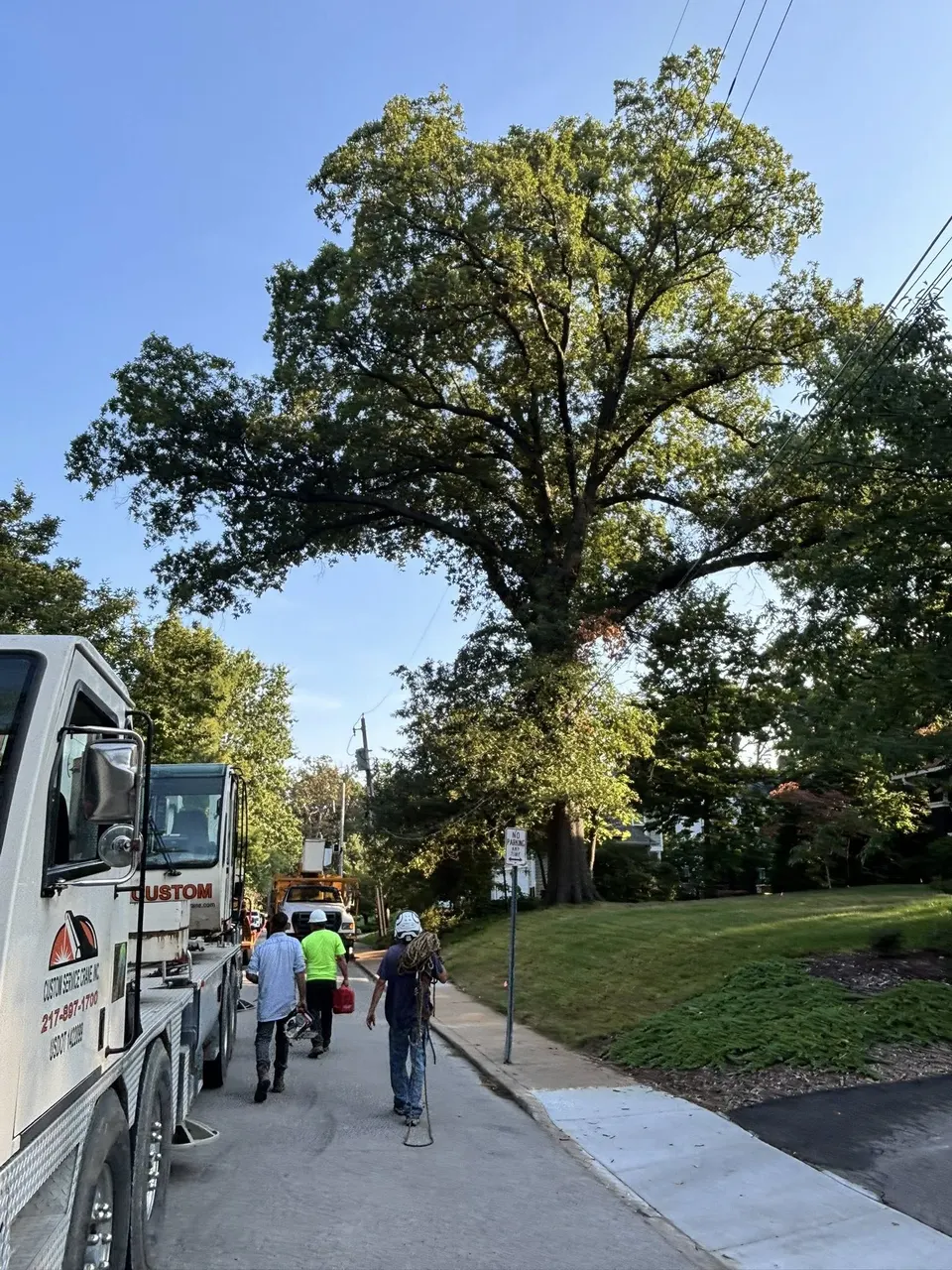
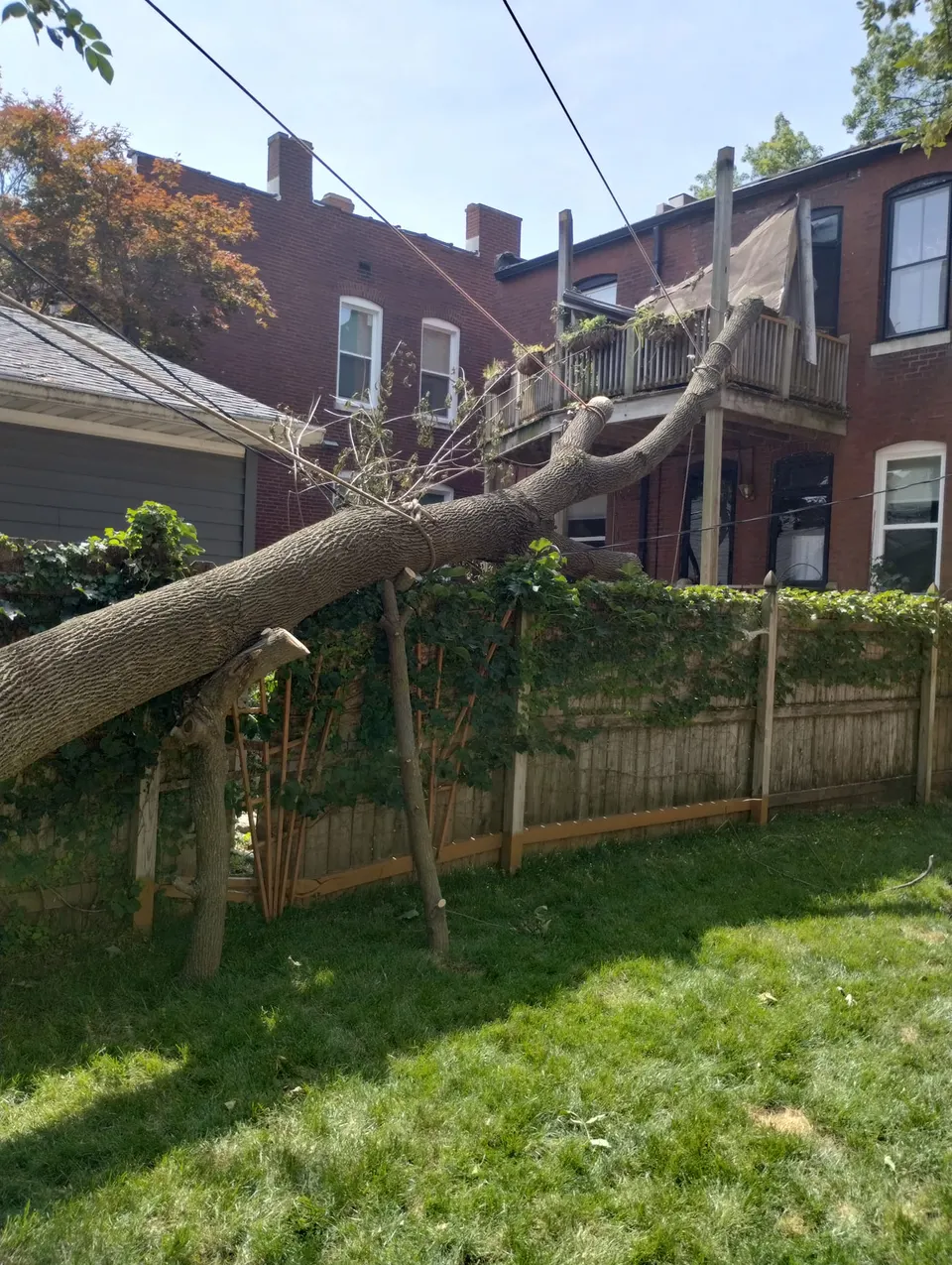
- Dead elms shed limbs. Mature American elms carry long, heavy horizontal branches. Once the wood dries, those limbs fail without warning, which turns a routine job into a dangerous tree removal. Our guide to the signs a tree is dead or dying covers how to judge how far gone it is.
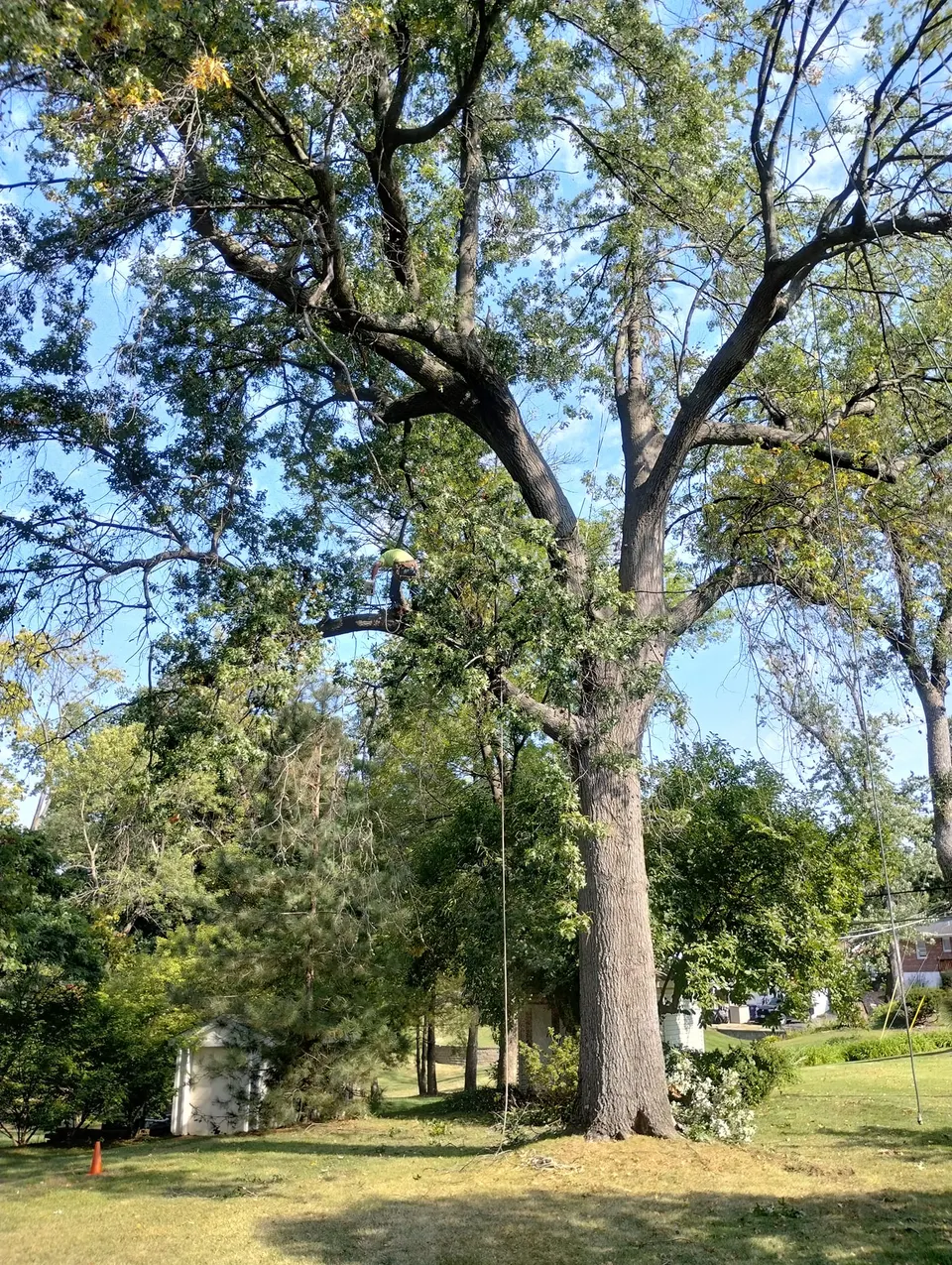
- It is cheaper now. An elm removed the season it dies can still be climbed and dismantled in sections. A brittle one has to be worked from a lift or crane with no climber in the tree, which takes longer and costs more.
Typical St. Louis-area tree removal runs $300-$2,500 or more. Mature American elms are big, wide trees and usually land at the high end, which is why most of these jobs go to our large tree removal crew rather than standard tree removal. Have the stump ground at the same time (see stump grinding); elm stumps left in place keep sprouting and remain attractive to beetles until the roots are dead.
What should you plant in place of a lost elm?
You can have an elm again. Decades of breeding have produced American elm cultivars that survive the disease at high rates: Princeton, Valley Forge, Jefferson, and New Harmony all keep the classic vase shape and are widely available. They are tolerant rather than immune, so plant them with space between them to limit root grafting, and keep an eye out for flags.
If you would rather not bet on elms at all, diversify. Bur oak, white oak, hackberry, and Kentucky coffeetree are long-lived Missouri natives that handle St. Louis clay and heat and are not affected by Dutch elm disease. A street or yard with several species survives the next disease far better than one with a single kind of tree, which is the lesson the elms taught in the first place.
Thompson Tree Care and Landscaping is licensed and insured, has completed more than 500 jobs across St. Louis, Kirkwood, Chesterfield, Florissant, O'Fallon, and Belleville since 2014, and holds a 4.8-star Google rating from 60+ reviews. Estimates are free, and we offer senior and veteran discounts. If an elm on your property is flagging, call (314) 712-3035 or request an estimate online and we will tell you plainly whether it can be saved and what it will take to protect the elms around it.
Frequently Asked Questions
Sometimes, if it is caught at the very first flag. When a single branch shows symptoms and less than roughly 5 percent of the crown is affected, an arborist can remove that limb 8 to 10 feet below the last brown streaking in the wood, and a licensed applicator can inject a fungicide. Once the fungus reaches the trunk or the tree got it through root grafts, it cannot be cured and should be removed.
Flagging: one branch high in the crown turns yellow, then brown, and the leaves curl and hang on instead of dropping, usually in late May through July. If you peel the bark off a wilted twig, the sapwood shows brown streaks or rings. From that first flag the disease spreads limb by limb and can kill the tree in one season or over two to three years.
Yes, but only to other elms. Elm bark beetles breed in dying elm wood and firewood and carry the fungus to healthy elms when they feed on twigs. Elms growing within about 50 feet of each other also share root grafts, and the fungus moves directly through them, which is why rows of street elms die one after another. Oaks, maples, and other species are not affected.
Typical St. Louis-area removal runs $300-$2,500 or more. Mature American elms are large, wide-spreading trees and usually land at the high end, especially over a roof or a street. Removing the elm promptly, while it can still be climbed, is cheaper than waiting until it is brittle. Thompson Tree Care estimates are free.